
The day before the first group attending our Montepulciano immersion trip in October was about to head home, I had a lovely conversation at breakfast with one of the participants. He was very curious to know how to express the following phrases in Italian:
- What do I have to do with it?
- What does this have to do with me?
Upon returning home and reflecting on the conversation, I realised just what a fantastic phrase of the week the Italian translation would make! (Grazie, Robert, for the inspiration!)
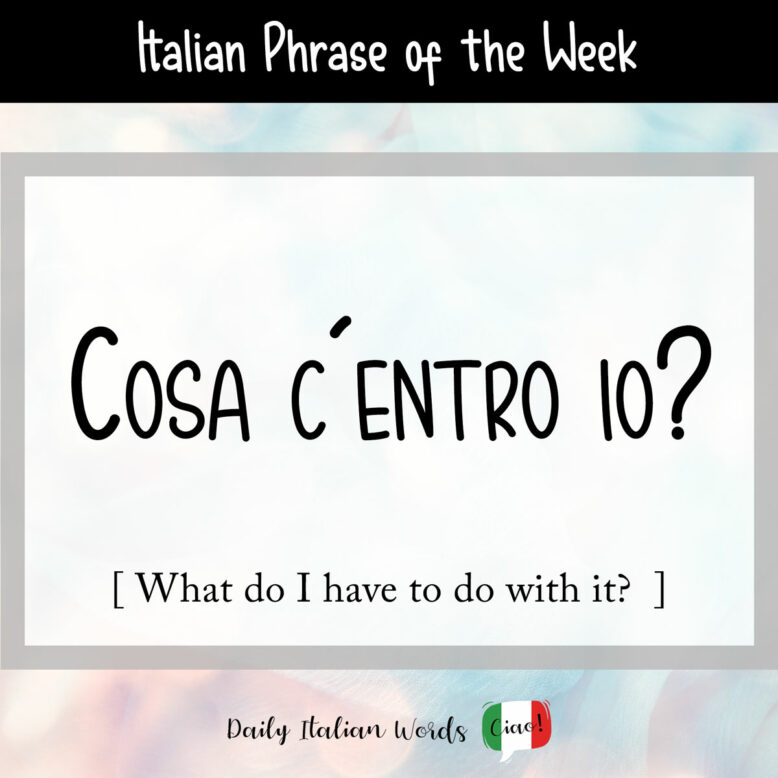
Cosa c’entro io?
Cosa c’entro io? or Che cosa c’entro io? is the Italian way of asking “What do I have to do with it?” and just as in English, it is often said defensively in response to an accusation or aggression of some sort. Let’s break it down bit by bit!
1. Cosa (or Che cosa)
Cosa literally means “what” but it can also mean “thing” depending on the context. If you put the optional che in front, the sentence takes on a slightly more formal nuance.
Cosa dici – vuoi questa cosa?
What are you saying – you want this thing?
2. Ci (abbreviated to c’)
Ci is a pronoun meaning “there / in it / with it” and in this particular expression, it refers to the situation being discussed. Ci doesn’t always have an exact translation in English, but it is a crucial part of Italian sentence structure.
Important: Ci + entro → c’ (elision because ci would clash with the vowel at the beginning of entro). It follows the same pattern as c’è (ci è) = there is.
3. Entro
Entro is the first-person singular form of entrare (“to enter”), so it literally means “I enter.” C’entro, on the other hand, comes from the verb entrarci, which expresses the idea of having enough space to fit into something — or not (Non c’entro più in questi pantaloni = I don’t fit into these trousers any more).
However, in the case of our phrase, entrarci takes on its other meaning: “to have something to do with”, “to be related”, “to be relevant”, or “to be involved”.
4. Io
Io is a pronoun meaning “I / me.” More often than not, io is grammatically unnecessary because the verb already shows the first person (e.g. entro ends with -o). However, in the case of this phrase, it has been added back for emphasis.
Now let’s take a look at a few example sentences:
Avete perso il treno e ora date la colpa a me? Cosa c’entro io?
You missed the train, and now you blame me? What do I have to do with it?
Litigate sempre e poi volete che prenda una posizione… ma cosa c’entro io?
You always argue and then you want me to take sides… what does this have to do with me?
Se il progetto non è stato approvato, cosa c’entro io? Non ne sapevo nulla!
If the project wasn’t approved, what did I have to do with it? I didn’t know anything about it!
Related forms
Cosa c’entro io? is just one of many ways to use the verb entrarci in a sentence. Here are a few other examples that crop up in conversation on a regular basis.
- Che c’entra? → What does that have to do with anything?
- Non c’entro niente → I have nothing to do with it
- C’entri tu! → You have something to do with it!
- In questa faccenda non voglio entrarci. → I don’t want to have anything to do with this matter!

Heather Broster is a graduate with honours in linguistics from the University of Western Ontario. She is an aspiring polyglot, proficient in English and Italian, as well as Japanese, Welsh, and French to varying degrees of fluency. Originally from Toronto, Heather has resided in various countries, notably Italy for a period of six years. Her primary focus lies in the fields of language acquisition, education, and bilingual instruction.