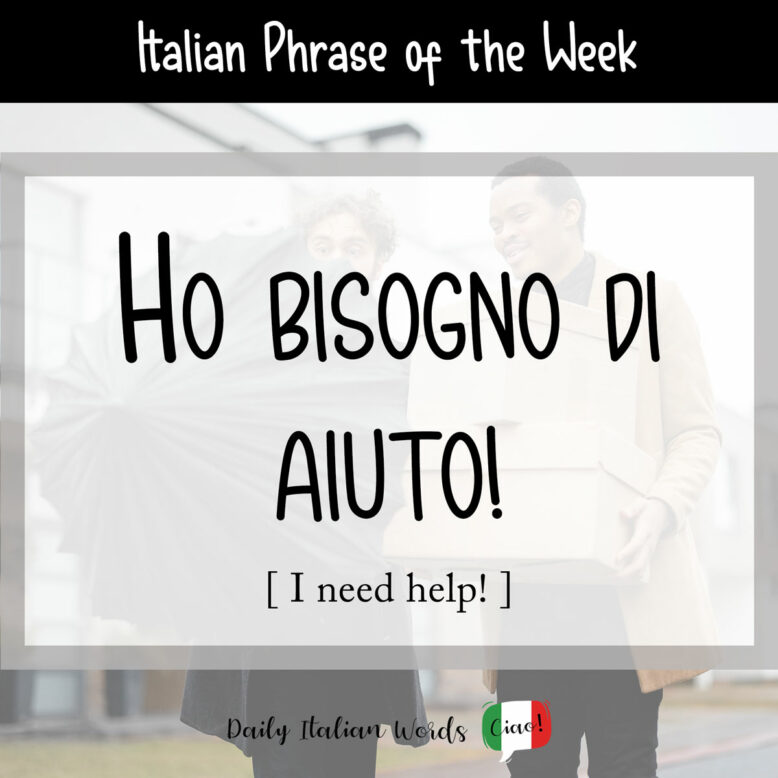
Today’s phrase is ho bisogno di aiuto and it can come in handy whenever you are in need of assistance in Italy. Let’s break it down into its smaller parts!
Ho bisogno di aiuto!
I need help!
The first part of the sentence, ho, is the first person singular of avere in the present tense. In other words, it equates to “I have” in English.
What’s interesting about Italian is that avere is often used in expressions of need, age, hunger, and so on. Take a look at the following common expressions:
- ho 20 anni (literally “I have 20 years”) – this means “I am 20 years old”
- ho fame (literally “I have hunger”) – this means “I am hungry”
- ho freddo / caldo (literally “I have heat / cold”) – this means “I am cold / hot”
This brings us to bisogno, which is a noun that means need. Combined with avere, it forms the idiomatic construction avere bisogno di… which means “to have need of.” Note that Italians don’t tend to say “I need” with a verb like in English. It is true that the verb bisognare exists, but it is impersonal and usually translates as “to be necessary / essential.” For example:
Bisogna leggere questo libro.
This book needs to be read. / It is necessary to read this book.
Di is a preposition meaning of. It links the “need” to what is needed, which in this case is the masculine singular noun aiuto (help / assistance). As in English, the article un (meaning a or an) is not needed here because “help” is being used in a general sense.
Note that, in addition to nouns, avere bisogno di can also be followed by verbs in their infinitive form such as:
- avere bisogno di dormire = to need to sleep
- avere bisogno di mangiare = to need to eat
- avere bisogno di bere = to need to drink
There is actually a second way of saying “I need…” in Italian, which is mi serve. It comes from the verb servire, which means to be necessary or to be needed. Unlike ho bisogno di, which can sometimes carry a stronger, more formal or explicit tone, mi serve is somewhat more impersonal and often more natural in casual speech. It places emphasis on the object that is necessary, rather than the person having a need.
Mi serve aiuto.
I need help. / Help is necessary for me.


Heather Broster is a graduate with honours in linguistics from the University of Western Ontario. She is an aspiring polyglot, proficient in English and Italian, as well as Japanese, Welsh, and French to varying degrees of fluency. Originally from Toronto, Heather has resided in various countries, notably Italy for a period of six years. Her primary focus lies in the fields of language acquisition, education, and bilingual instruction.