Today we’re going to take a look at a simple yet incredibly versatile Italian phrase: lasciare stare, which can also be written and said as lasciar stare.
Literally, it translates as “to leave it to stay” (lasciare = to leave, stare = to stay/to be), but this obviously makes little sense in English.
Let’s take a moment to explore its different meanings and possible translations!
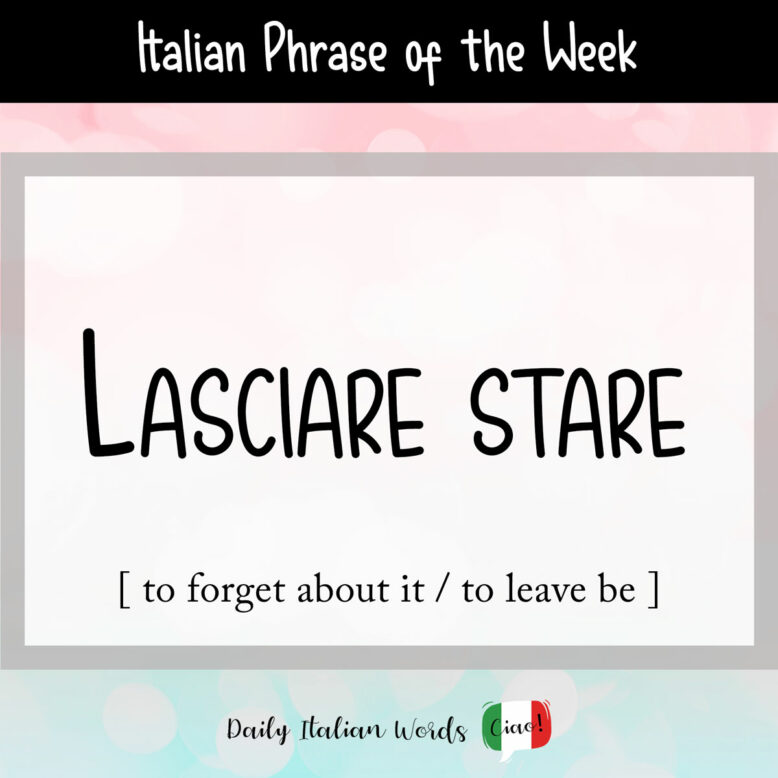
1. To forget about it/something
Italians tend to use this phrase when they feel it’s time to move on from a topic that’s been discussed ad nauseam. A similar expression in English would be “to drop it” or “to drop something.”
Lasciamo stare, è inutile parlarne con lui.
Let’s drop it, it’s useless talking about it with him.
You might also hear Ma lascia stare! which is similar to saying Oh, just forget it! or Oh, just drop it! in English.
2. To leave alone / to leave be
This second meaning more closely reflects the literal translation, with lasciare meaning “to leave” and stare meaning “to stay” or “to be,” depending on the context.
As in English, it can be used to say that we should stop bothering someone, avoid getting involved in a situation, or refrain from touching or changing something for fear of breaking it.
Lascia stare tua sorella!
Leave your sister alone!
Lascia stare la lampada. È delicata.
Leave the lamp alone. It’s fragile.
You can also expect to hear the phrase lasciare in pace (to leave in peace) in the place of lasciare stare when a person is involved.

3. To not worry
If you want to tell someone not to worry or not to bother with something, you can use lasciare stare to gently suggest they shouldn’t concern themselves. For example, if you’re at a restaurant and your friend tries to pay, you could say:
Lascia stare, pago io.
Don’t worry, I’ll pay.
4. To put aside
This meaning is quite similar to the first one, in that it implies something should be forgotten or put to one side for the time being.
Dovremmo lasciare stare il lavoro quando siamo con nostro figlio.
We should put our work aside when we are with our son.

Heather Broster is a graduate with honours in linguistics from the University of Western Ontario. She is an aspiring polyglot, proficient in English and Italian, as well as Japanese, Welsh, and French to varying degrees of fluency. Originally from Toronto, Heather has resided in various countries, notably Italy for a period of six years. Her primary focus lies in the fields of language acquisition, education, and bilingual instruction.