Since I began learning languages over 20 years ago, one thing that has always struck me is how often different languages have idioms or proverbs that convey the same idea, yet express it in completely different ways. A good example is today’s proverb, Il mattino ha l’oro in bocca, which roughly corresponds to the English “The early bird catches the worm.” The literal translations, however, couldn’t be more different, as we’re about to discover.
Il mattino ha l’oro in bocca
The early bird catches the worm
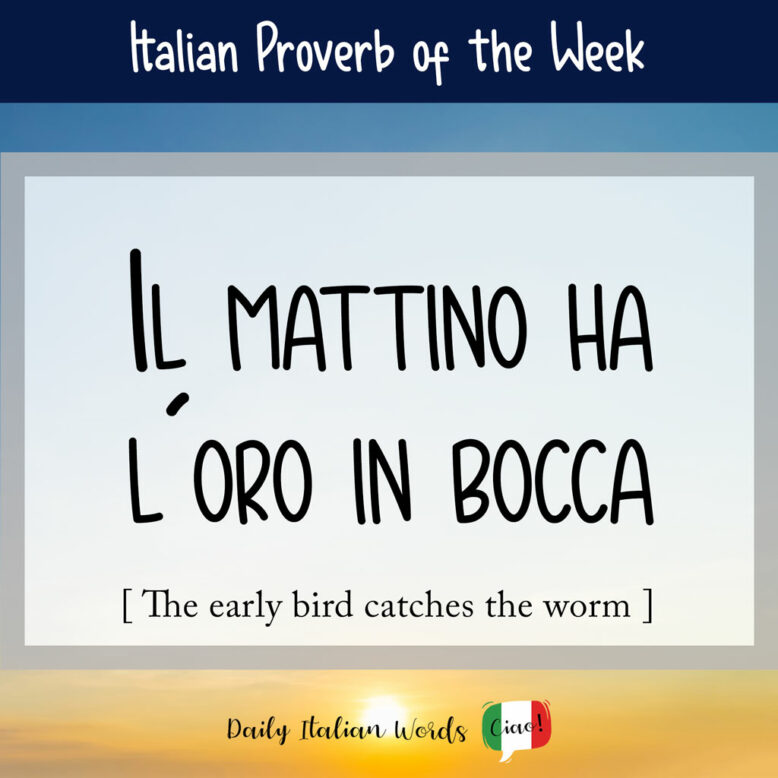
The literal translation of this proverb is “the morning has gold in its mouth.” Gold in the mouth, you say? Taken at face value, it doesn’t make much sense. But if we look back to the original Roman proverb, Aurora aurum in ore habet, everything becomes much clearer.
Here we see the word aurora, which in Latin means “daybreak,” alongside aurum, the word for gold. The word ore (“mouth”) is used figuratively to refer to the beginning of the day – the moment when the sun emerges.
The idea behind this phrase is that the morning is the most productive time of the day because our minds our well-rested. For example, the language learner who religiously gets up at 6am to study before heading to work will likely be more successful, and fit in more effective study time, than the learner who wakes up late and leaves everything until the end of the day. (I wish I could say that I was that kind of language learner, but I’m not!)
Il mattino ha l’oro in bocca: meglio iniziare a lavorare presto.
The early bird catches the worm: better start working early.
And as an interesting side note, while researching for this article, I also discovered that this same proverb also exists in German!
Il mattino ha l’oro in bocca is also the title of a 2008 film directed by Francesco Patierno, inspired by the book Il giocatore (ogni scommessa è debito), an autobiography by co-screenwriter Marco Baldini.


Heather Broster is a graduate with honours in linguistics from the University of Western Ontario. She is an aspiring polyglot, proficient in English and Italian, as well as Japanese, Welsh, and French to varying degrees of fluency. Originally from Toronto, Heather has resided in various countries, notably Italy for a period of six years. Her primary focus lies in the fields of language acquisition, education, and bilingual instruction.