In its most basic form, posto in Italian means “place” or “location.” But listen to any Italian conversation and you’ll hear it used in all kinds of ways. It can refer to your seat at the dinner table, that little café with the perfect espresso, and much more. Surprised? Keep reading!
posto
place / location
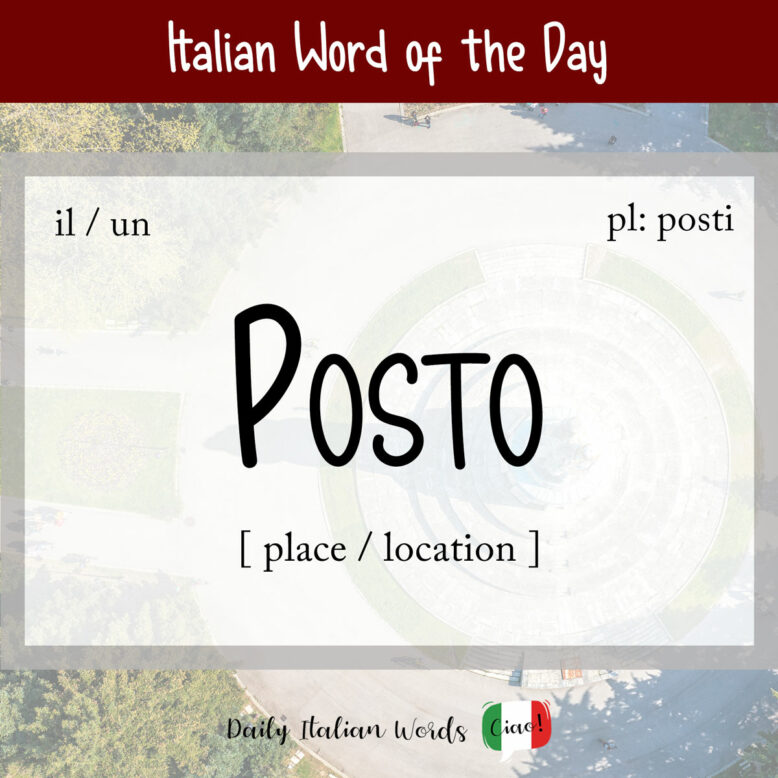
Grammatically, posto is a masculine noun, and its plural is posti. Here are its definite and indefinite articles:
- il posto = the place
- i posti = the places
- un posto = a place
- dei posti = some places
Here’s how you should use it:
1. POSTO = Place / location
In its most literal sense, posto means “place” or “location” in a broad, general way, without specifying exactly what kind of place it is.
Ieri siamo stati in un posto meraviglioso appena fuori Roma
Yesterday we visited a wonderful place just outside Rome.
Questo posto non è adatto ai bambini, è pericoloso!
This place is not suitable for children, it’s dangerous!

2. POSTO = Space / room
Posto can also mean “space” or “room,” either the physical kind like space in your closet or something more abstract or metaphorical, like space in your heart.
Avete posto in macchina per un’altra persona?
Do you have room in the car for one more person?
Non c’è posto per altri nel mio cuore, solo per te!
There’s no room in my heart for anyone else, only for you!
Here are some common expression with posto used in this sense:
- Fare posto (to make room)
- Trovare posto (to find space)
- Esserci posto (there is room)
If the “room” or “space” is for something specific, posto often combines with another word to form compound expressions like:
- Posto auto (a designated spot for a car)
- Posto di blocco (roadblock, checkpoint)
- Posto letto (bed space – a place to sleep, often in hostels)
Finally, when asking for space politely (or hopefully), we often use the diminutive form posticino (“a little space”) to soften the request, as if we’re saying “just a tiny bit of room, if possible.” For example:
Riesci a farmi un posticino nella tua valigia? Non so dove mettere i libri che ho preso ieri.
Can you make a little space for me in your suitcase? I don’t know where to put the books I bought yesterday.

3. POSTO = A public place
In everyday Italian, posto can simply mean a “public place,” something like a bar, restaurant, café, or shop. It’s a handy word you can use when you don’t need or don’t know the specific term for the place you have in mind.
Imagine you’re in the middle of nowhere, it’s hot and you’re desperate for an iced tea. You can stop a local and ask:
Mi scusi, c’è qualche posto in cui bere qualcosa qui vicino?
Excuse me, is there a place nearby where I can get something to drink?
We love using the diminutive form, posticino, for describing a cozy, charming, or “hidden gem:”
Stasera ti porto a mangiare in un posticino che fa una pizza strepitosa!
Tonight I’m taking you to a cute place that makes amazing pizza!
Naturally, there’s also the pejorative form, postaccio. It refers to somewhere we’d rather not be, often because it feels unsafe, dirty, or just has bad vibes. For example:
Ieri sera siamo finiti in un postaccio dove servivano cibo immangiabile.
Last night we ended up in a terrible place where they served inedible food.
4. POSTO = Seat
Posto is also commonly used to mean “seat.” This can refer to a seat on public transport, at an event, in a classroom, or even at the dinner table with friends or family.
Ho prenotato due posti in prima classe sul treno delle 11:45.
I booked two first-class seats on the 11:45 a.m. train.
Quel secchione di Stefano si mette sempre nei posti davanti per fare bella figura con gli insegnanti.
That nerd Stefano always sits in the front to impress the teachers.
And when you’re at a friend’s house for dinner and want to know where to sit, you might ask:
Qual è il mio posto?
Which seat is mine?
5. POSTO = Job / position (in the workplace)
When talking about work, posto means a job or a position within a company or organisation.
Mia figlia si è laureata a novembre e ha già trovato un buon posto.
My daughter graduated in November and has already found a good job.
Here are some common expressions with posto related to work that you might hear:
- Avere un buon posto (to have a good job, usually implying stability, good pay, or prestige)
- Perdere il posto (to lose one’s job, generally referring to being laid off or fired)
- Avere/occupare un posto di responsabilità (to have/hold a role with important duties and authority)
6. POSTO = Position
Another meaning of posto in Italian it to talk about the position someone holds in a queue or a ranking. For example, if you’re standing in line at the pharmacy but need to step away for a moment and want to make sure no one takes your spot, you can ask the person next to you:
Per favore, può tenermi il posto? Torno subito.
Could you please save my spot? I’ll be right back.
Here’s an example when talking about rankings in sports and competitions:
La nostra squadra ha raggiunto il primo posto in classifica!
Our team made it to first place in the rankings!
7. POSTO = Put / placed
Posto isn’t always a noun. It can also be the past participle of the verb porre, which means “to put” or “to place.” In Italian, we have another verb with a similar meaning, mettere, but porre is a bit more formal or often appears in specific expressions, such as:
- Porre l’accento (to stress, to put emphasis)
- Porre fine a qualcosa (to put and end to something)
- Porre rimedio (to find a solution)
- Porre un freno (to put a stop)
Durante la riunione, il cliente ha posto l’accento sull’importanza della puntualità.
During the meeting, the client stressed how important it is to be on time.
Hanno posto fine alle trattative senza un accordo.
They put an end to the negotiations without an agreement.
Common idioms and expressions with POSTO in Italian
And finally, here are some useful phrases with posto that you’ll hear in everyday Italian:
Al posto di: Instead of, in place of
We use this expression when we want to say that one thing replaces another or happens instead of something else.
Al posto di lamentarci, proviamo a trovare una soluzione!
Instead of complaining, let’s try to find a solution!
Al posto tuo / Al tuo posto: If I were you, in your shoes
This is very useful when giving advice, making suggestions, or imagining yourself in another person’s situation.
Al posto tuo, andrei subito a cercarlo.
If I were you, I’d go look for him right away.
If you want to use a person’s name, you can say al posto di + name, for instance:
Al posto di Chiara, me ne sarei stata zitta!
If I were Chiara, I’d just have stayed quiet!
Posto che: Assuming that
This phrase sets a premise or hypothetical situation before stating what follows.
Posto che tu abbia ragione, mi spieghi come facciamo a rintracciarli?
Assuming you’re right, how do we track them down?
Sul posto: On the spot, at the scene
This refers to being exactly where something occurs.
I vigili del fuoco sono arrivati subito sul posto.
The firefighters arrived immediately on the spot.
A posto: Alright, in order, sorted
This literally means “in place,” but, often used in expressions like:
- Essere a posto (to be ok)
- Mettere a posto (clean up, fix, repair)
- Sentirsi a posto con la coscienza (to feel at peace with your conscience)
Hai messo a posto la televisione? Stasera ci sono le nuove puntate dell’Amica Geniale!
Did you fix the TV? Tonight there are new episodes of My Brilliant Friend!
Qui è tutto a posto, voi come state?
Everything’s fine here, how are you?
This phrase can also describe a person who is decent, honest, or mentally balanced, in expressions like:
- Essere una persona a posto (to be a good, reliable person)
- Avere la testa a posto (to be right in the head, mentally sound)
È un tipo a posto, non c’è da preoccuparsi.
He’s a stand-up guy, nothing to worry about.
Important: Don’t confuse a posto with apposto. They sound identical but mean different things:
- a posto – in order, sorted
- apposto – placed or affixed (it’s the past participle of apporre)
Siamo a posto!: That’s just great!
We say it ironically to express frustration when something goes wrong. Depending on the tone, it can sound either playful or rather annoyed.
Il treno è in ritardo di due ore e si è messo pure a piovere… Siamo a posto!
The train’s two hours late and now it’s started raining too… that’s just great!
Mettere qualcuno al suo posto: To put someone in their place
We use it figuratively when someone is being rude or arrogant and we confront them, showing them they’ve crossed a line or need to behave properly.
Il mio collega Fabio è troppo arrogante, ma l’ho messo al suo posto durante la riunione.
My colleague Fabio was being way too arrogant, but I put him in his place during the meeting.
Stare al proprio posto: Not interfere
That’s something we say when telling someone not to get involved in matters that don’t concern them. It’s like saying “mind your own business,” for example:
Stai al tuo posto e lascia fare a chi ne sa di più!
Mind your own business and let those who know better handle it!
Trovare il proprio posto nel mondo: To find one’s place in the world
This expression is used in Italian just like in English to mean discovering where you truly belong or feel comfortable.
Mio fratello si è trasferito in Canada, là ha trovato il suo posto nel mondo.
My brother moved to Canada, that’s where he found his place in the world.
Un posto vale l’altro: One place is as good as another
We use it to say that the specific location doesn’t matter; any option will do.
Scegli tu dove andare a cena. Per me un posto vale l’altro, basta che sia tranquillo.
You pick where we go for dinner. Any place will do, as long as it’s quiet.
Un posto al sole: A place in the sun
This idiom refers to a prestigious economic or social position, like when talking about someone achieving success or gaining recognition. It dates back to colonial times, when Western powers competed for “a place in the sun,” a metaphor for claiming control in sought-after regions like Africa. Fun fact: Un posto al sole is also the title of Italy’s longest-running soap opera, set in Naples (watch here).
Dopo anni di sacrifici, si sono conquistati il loro posto al sole.
After years of hard work, they earned their place in the sun.

Valentina Nicastro is a travel writer in love with her home country, Italy. Having travelled widely around the globe, she realised there was more to explore closer to home and decided to put the passport aside for a while. When she is not immersed in documenting Italy, you’ll find her donning her communication consultant hat, weaving words as a content writer and bridging linguistic divides as a translator.