The other day, my son and I were in the living room, playing shop with his stuffed animals. At one point, he pretended that one of the toys walked out of his supermarket without paying for an apple, and in that moment, I realised I didn’t have a clue how to translate the word shoplifter into Italian. Sure, it isn’t a term we use every day, but having looked it up and researched it, I can confirm that it’s a fun one to add to your arsenal!
taccheggiatore
shoplifter
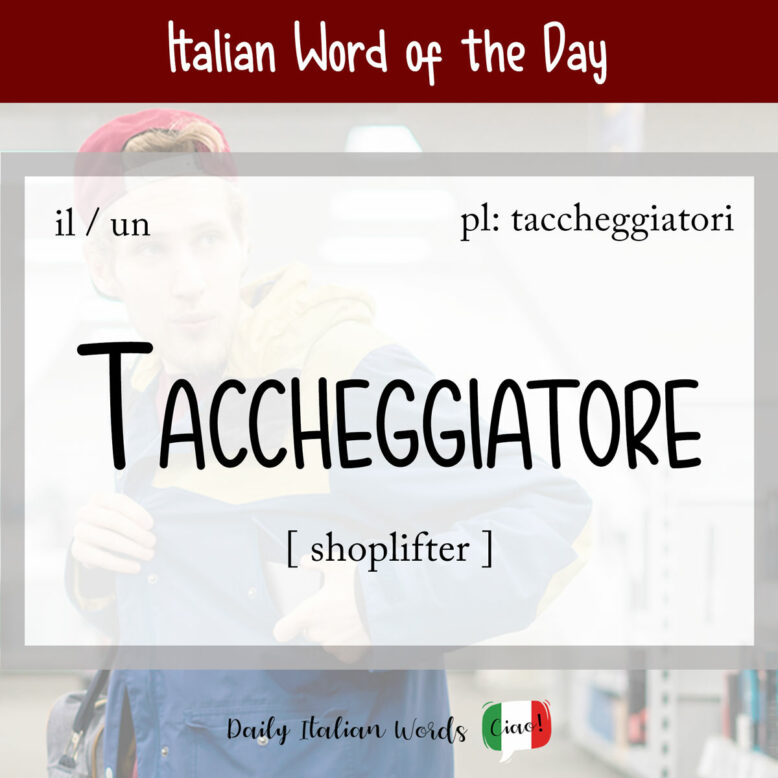
This masculine noun, which also has the feminine equivalent taccheggiatrice, derives from the verb taccheggiare which means, you guessed it, to shoplift. Here are its definite and indefinite articles:
- il taccheggiatore
- i taccheggiatori
- un taccheggiatore
- dei taccheggiatori
- la taccheggiatrice
- le taccheggiatrici
- una taccheggiatrice
- delle taccheggiatrici
This isn’t the only meaning of taccheggiare however – it can also refer to the act of applying strips of paper to the cylinder of the printing press in places where the impression is weak. These strips are called tacchi in Italian, which is where the verb comes from. (Source: Treccani)
Interestingly, the two verbs do not share an etymological root, despite being spelled and pronounced in the same way. The origin of the taccheggiare we are exploring today is actually uncertain.
La polizia ha arrestato il taccheggiatore mentre usciva dal negozio.
The police arrested the shoplifter as he left the shop.
As you might have guessed, shoplifting as a noun is known as taccheggio in Italian.
Il taccheggio è un reato.
Shoplifting is a criminal offence.
In many shops, you will see anti-taccheggio (literally an “anti-shoplifting”) technology used in order to to prevent shoplifting from stores, unwanted removal of properties from office buildings, or pilferage of books from libraries.
If you want to talk about theft in more general terms, it is better to use the noun furto (theft) and the verb rubare (to steal). Some other interesting terms related to theft include:
- borseggiare = to pickpocket (borseggiatore / borseggiatrice = pickpocket)
- derubare = to rob (someone), it can also mean “to rip off”
- rapinare = to rob but with the threat of violence (e.g. rapinare una banca = to rob a bank)
- svaligiare = to burgle, to ransack, or to clean out a place
- rubacchiare = to filch or pilfer
- scippare = to bag-snatch / to purse-snatch
- fregare = the slang equivalent of rubare


Heather Broster is a graduate with honours in linguistics from the University of Western Ontario. She is an aspiring polyglot, proficient in English and Italian, as well as Japanese, Welsh, and French to varying degrees of fluency. Originally from Toronto, Heather has resided in various countries, notably Italy for a period of six years. Her primary focus lies in the fields of language acquisition, education, and bilingual instruction.