
I’ve never really understood why mothers-in-law get such a bad rap. Whilst living in Torino, my suocera gave me a place to live when I wasn’t earning enough to rent my own apartment, cooked for me when I got home late from work in the evening, and I would even say that she was solely responsible for bringing my Italian language skills up to scratch during that first year I lived in Italy! Do we butt heads at times? Sure, but I could say the same about my own mamma. I guess what I want to say is that not all suocere are out to get their child’s partner, despite the reputation that precedes them!
suocera
mother-in-law
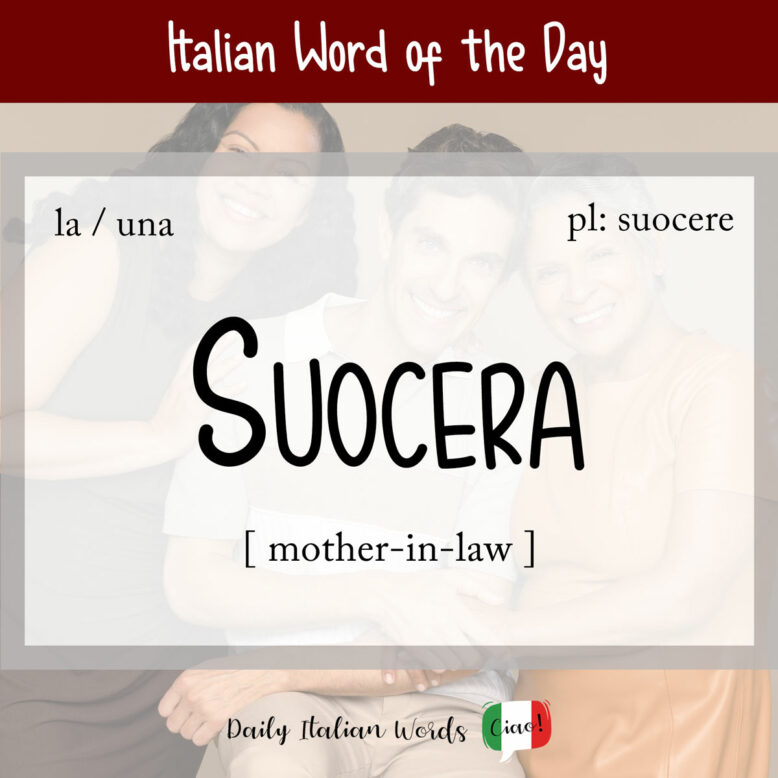
As we’ve seen, the Italian word for mother-in-law is suocera. It comes directly from the late Latin sŏcera, so no mysteries there!
From this, we can draw the logical conclusion that the masculine equivalent is suocero, father-in-law. I am my mother-in-law’s nuora (daughter-in-law) while my husband is my mother’s genero (son-in-law).
It is a feminine noun that takes the following definite and indefinite articles:
- la suocera
- le suocere
- una suocera
- delle suocere
Here are some other family members you might want to become familiar with:
- mamma = mom
- papà = dad
- fratello = brother
- sorella = sister
- marito = husband
- moglie = wife
- zio = uncle
- zia = aunt
- figlio = son
- figlia = daughter
- cognato = brother-in-law
- cognata = sister-in-law
- cugino = male cousin
- cugina = female cousin
Io vado d’accordo con mia suocera – e tu?
I get along with my mother-in-law – how about you?
The expression fare la suocera (literally “to do the mother-in-law”) is a figurative way of describing someone who behaves in an authoritarian manner, harking back to the reputation mother-in-laws have of being overbearing.
Dai, non fare la suocera!
Oh, come on, don’t act like a mother-in-law!

Heather Broster is a graduate with honours in linguistics from the University of Western Ontario. She is an aspiring polyglot, proficient in English and Italian, as well as Japanese, Welsh, and French to varying degrees of fluency. Originally from Toronto, Heather has resided in various countries, notably Italy for a period of six years. Her primary focus lies in the fields of language acquisition, education, and bilingual instruction.