I often joke with my son about the sheer quantity of stuffed animals he’s accumulated over the years – some inherited from my own rather abundant collection, others given to him as presents. If I were to count them all, I’m pretty sure I’d still be here in an hour’s time!
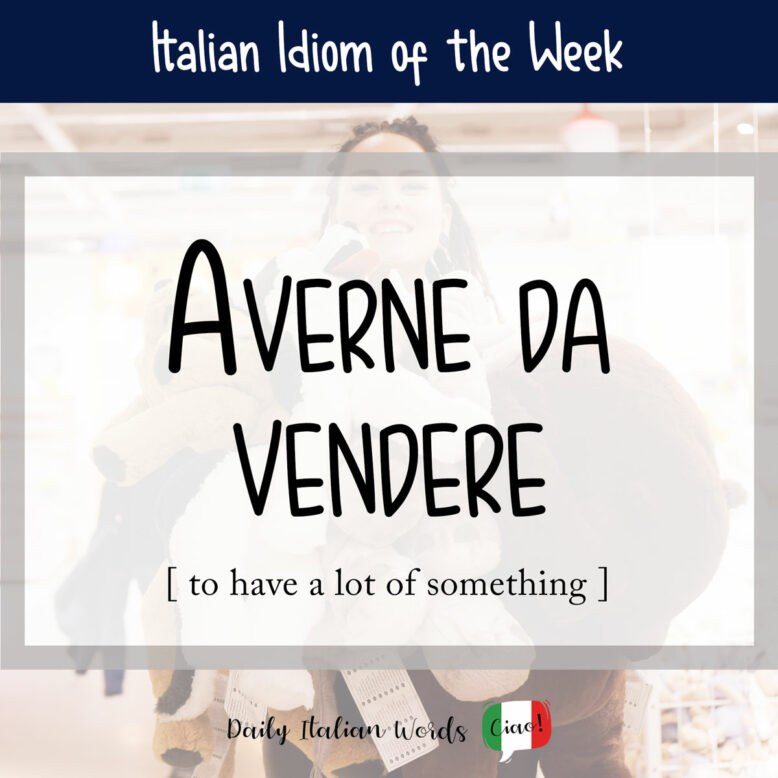
An expression that perfectly describes my son’s stuffed toy situation is averne da vendere, which is an idiomatic way of saying that someone has a lot of something. The literal translation is something along the lines of “to have (a lot) of them to sell.”
averne da vendere
to have a lot of something
The verb avere means “to have” and it has been paired with the pronoun ne which can be translated in various ways depending on the context:
- of it, of him, of her, of them, of this, of that
- about it, about him, about her, about them, about this, about that
In the case of this expression, it is best translated as to have (a lot) of it or to have (a lot) of them, with the “a lot” part being implied.
Here is how avere should be conjugated in the present tense with ne:
- Ne ho = I have (of it/them)
- Ne hai = You have (of it/them)
- Ne ha = He/she has (of it/them)
- Ne abbiamo = We have (of it/them)
- Ne avete = You all have (of it/them)
- Ne hanno = They have (of it/them)
Vendere is a verb that means to sell. It is preceded by the preposition da which, in this case, should be translated as to. This da + infinitive structure is extremely common in Italian, so it’s worth committing to memory. Let’s see a few other examples of how it is used in Italian, along with its corresponding translations. As you can see, there isn’t one straightforward translation that works for each phrase, but it tends to suggest that something needs to be done, can be done, or is worth doing.
- Questo è stato un anno da ricordare.
- This was a year to remember.
- This was a year to be remembered.
- This was a year worth remembering.
- Torino è una città da visitare.
- Torino is a city worth visiting.
- Torino is a city that should be visited.
- Matteo è una persona da conoscere.
- Matteo is a person worth knowing.
- Matteo is a person you need to know.
- Ne ho da fare, ma prima un po’ di relax.
- I have stuff to do, but first a little bit of relaxation.
- I have stuff I need to do, but first a little bit of relaxation.
- I have stuff that needs doing, but first a little bit of relaxation.
- Hai qualcosa da bere?
- Do you have something to drink?
- Do you have something I can drink?
In everyday conversation, this expression is often preceded by the preposition di (of) + the abundant object in question. For example:
- Di pazienza ne ho da vendere = I have lots of patience (literally “Of patience I have a lot of it to sell”)
- Di libri ne ha da vendere = He/she has lots of books (literally “Of books, he/she has a lot of them to sell”)
Hai una penna? – Ne ho da vendere!
Do you have a pen? – I have lots of them!


Heather Broster is a graduate with honours in linguistics from the University of Western Ontario. She is an aspiring polyglot, proficient in English and Italian, as well as Japanese, Welsh, and French to varying degrees of fluency. Originally from Toronto, Heather has resided in various countries, notably Italy for a period of six years. Her primary focus lies in the fields of language acquisition, education, and bilingual instruction.