Today we will be investigating a word that has a variety of meanings depending on the context: carico, which comes from the verb caricare (to load / to charge). This verb, in turn, comes from the Late Latin carrĭcare, a derivative of carrus meaning carro (cart / wagon).
carico
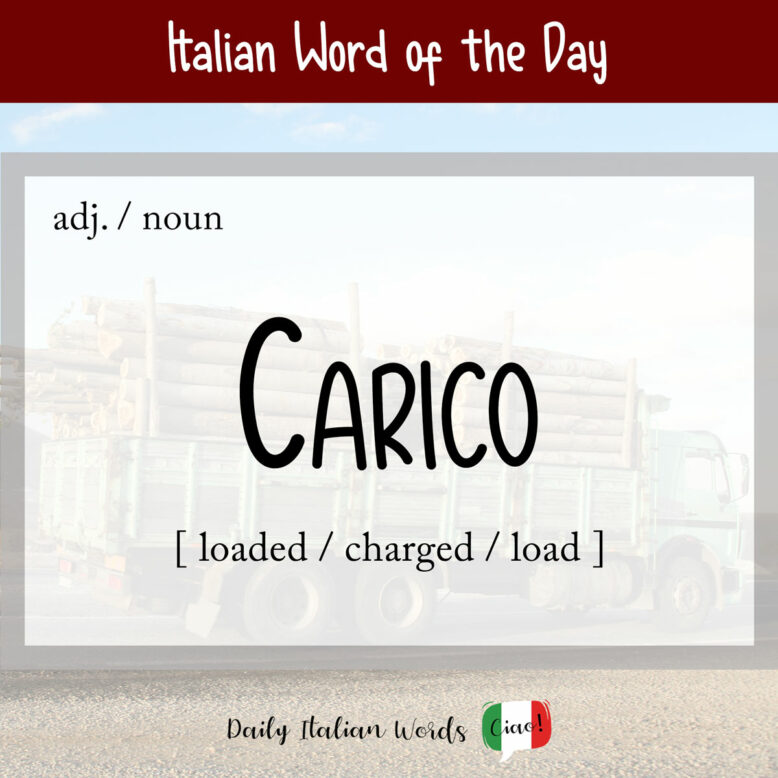
First, let’s get the grammar out of the way. Carico can function as either an adjective or a noun. When used as an adjective, the ending must match the gender and number of the subject in question:
- carico – masculine, singular
- carica – feminine, singular
- carichi – masculine, plural
- cariche – feminine, plural
When used as a noun, on the other hand, the ending remains masculine.
- il carico
- i carichi
- un carico
- dei carichi
Carico, the adjective, is normally translated as loaded or laden when referring to physical objects, such as vehicles or boxes, that are full to capacity or near-capacity.
La nostra macchina è carica di bagagli.
Our car is loaded with luggage.
However, an equally common translation is charged, loaded or wound up when referring to an object that is full of something and thus ready to be used. Think of un cellulare carico (a charged cellphone), una batteria carica (a charged battery), un orologio carico (a wound-up clock), or un fucile carico (a loaded gun).
Mi sono svegliato stamattina solo per scoprire che il mio telefonino non era carico.
I woke up this morning only to discover that my phone wasn’t charged.
Carico may also be used to describe strong or deep colours, as in un blu carico (a strong blue), as well as strong tea or coffee.

Moving on to the figurative meanings of carico, we have laden down, weighed down or burdened, all of which are used when describing different kinds of metaphorical loads or burdens. You might be carico di lavoro (burdened with work) if you have a very demanding job, or carico di debiti (up to your ears in debt) if you’ve been a bit too spend-happy with your credit card over the past couple of years.
Essere carico (to be charged) is also used to say that you are motivated to do something, or that you are “up for” something, such as a challenge.
Sono carico per questa nuova sfida!
I’m up for this new challenge!
So, what about carico the noun? As you might have guessed, it normally translates as load, as in a heavy or bulky thing that needs to be carried or a weight held up by a structure. More specific translations that work just as well include cargo, freight, shipment or payload.
Il camion trasportava un carico di banane.
The truck was transporting a load of bananas.
It is extremely common for carico – and more specifically the expressions a carico di and in carico – to be used when describing someone or something that is the responsibility of another person. Here are a few examples of how you might see these expressions used in everyday Italian:
- prendere in carico = to take (someone) into one’s care
- prendersi carico = to take on the responsibility / management of something
- farsi carico di = to take on / to take charge
- familiari a carico = dependants
- essere a carico di qualcuno = to be supported by someone
Il bambino è a carico della zia.
The child is in the aunt’s care.
A carico can also mean that something is payable by someone, as in the phrase oneri a carico del cliente (charges to be paid by the customer).
The same expression can be seen in legal terminology, as in essere a carico di qualcuno (to be against someone) and testimone a carico (witness for the prosecution).

Let’s bring this article to a close with an interesting idiomatic expression – metterci il carico da undici – which literally translates as something along the lines of “to put the load on eleven.” It is used when someone does something to make an already bad situation much worse by adding a final, crushing blow.
It originates from one of Italy’s most popular card games, Briscola. In the deck, the Aces have the highest point value of 11 points each, and in card game jargon, these high-value cards are referred to as – you guessed it – carichi. When a player drops an Ace of Briscola onto a trick, they are “putting the 11-point load” on the table to secure the points and assert dominance over the round.

Heather Broster is a graduate with honours in linguistics from the University of Western Ontario. She is an aspiring polyglot, proficient in English and Italian, as well as Japanese, Welsh, and French to varying degrees of fluency. Originally from Toronto, Heather has resided in various countries, notably Italy for a period of six years. Her primary focus lies in the fields of language acquisition, education, and bilingual instruction.