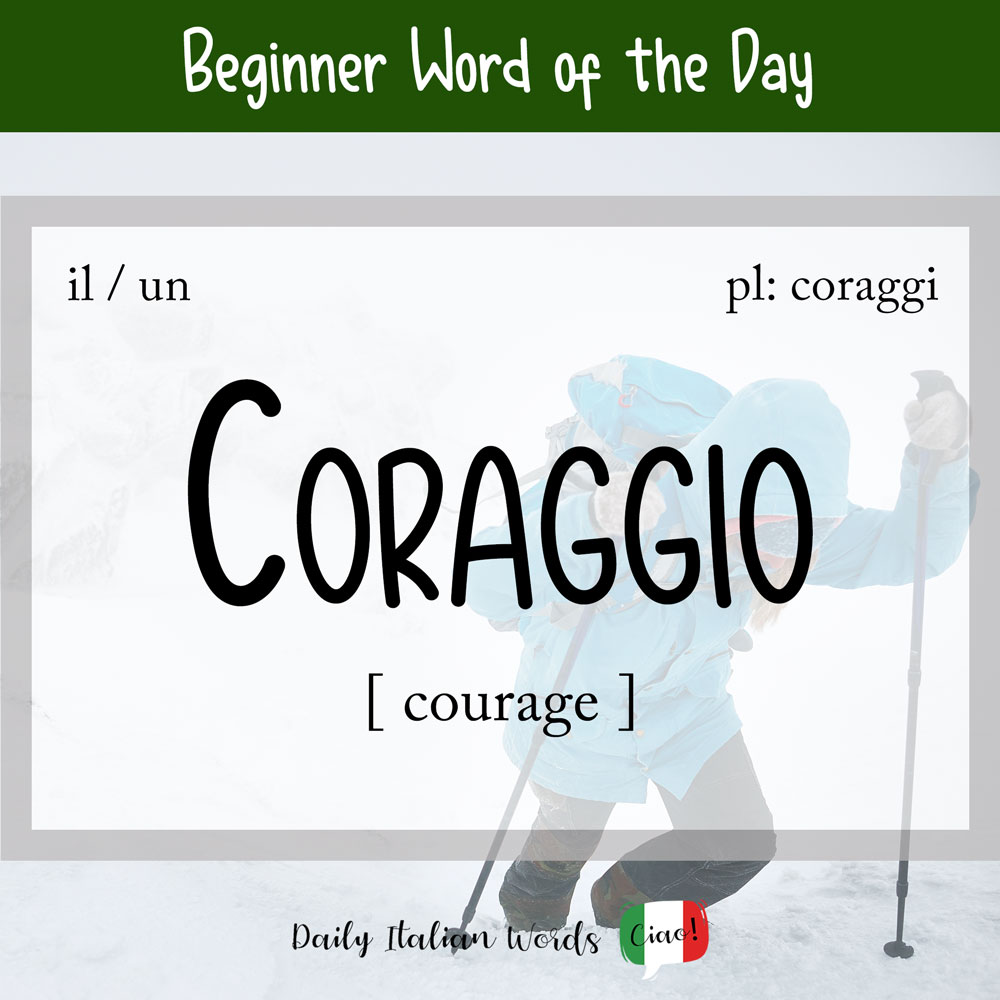
Italian Word of the Day: Coraggio (courage)

The word for courage or bravery in Italian is coraggio. It comes from the Latin cor meaning heart. If you are facing an intimidating situation, you may want to find ways to pluck up your courage, which in Italian translates as farsi coraggio or trovare il coraggio. È nei momenti più difficili che bisogna farsi …

Read more

Italian Word of the Day: Libro (book)

The word for book in Italian is libro (masculine, plural: libri), which comes from the Latin word liber. If you find it hard to remember, just think of the English word library! Before the Latin word came to mean book, it indicated the inner bark of some plants which, when dried, was used as a …

Read more

Italian Word of the Day: Quarantena (quarantine)

The word for quarantine in Italian is the extremely similar quarantena (feminine, plural: quarantene). Although today it refers to an indefinite period of isolation for people or animals exposed to infectious or contagious diseases, it was originally a 14th-15th century Venetian word used to describe a precise forty-day (quaranta giorni) period of isolation for the …

Read more

Italian Word of the Day: Zio (uncle)

The word for uncle in Italian is zio (masculine, plural: zii). It comes from the Latin word thius and, as in English, is used to describe the brother of one’s mother or father, or the husband of one’s aunt (zia). Mio zio abita in Canada da dieci anni. My uncle has lived in Canada for …

Read more

Italian Word of the Day: Zaino (backpack)

The word for backpack, knapsack or rucksack in Italian is zaino (masculine, plural: zaini). lo zainouno zaino gli zainidegli zaini It refers to any bag with shoulder straps, including those carried by hikers, soldiers, and school children. Non mi serve una valigia. Lo zaino è più che sufficiente. I don’t need a suitcase. The backpack …

Read more

Italian Word of the Day: Pietra (rock, stone)

The Italian word pietra (feminine, plural: pietre) can be translated as either rock or stone in English. It comes from the Greek word πέτρα (pétrē). As you can see from the two examples below, pietra is used to talk about both the compact mass formed by natural mineral substances, as well as the smaller fragments …

Read more