
Whenever I’m out on a walk in the countryside, particularly following una giornata piovosa (a rainy day), I pay extra attention to not step on the many chiocciole (snails) that come out of hiding. I always feel terrible when I do accidentally pestarne una (step on one)!
chiocciola
snail
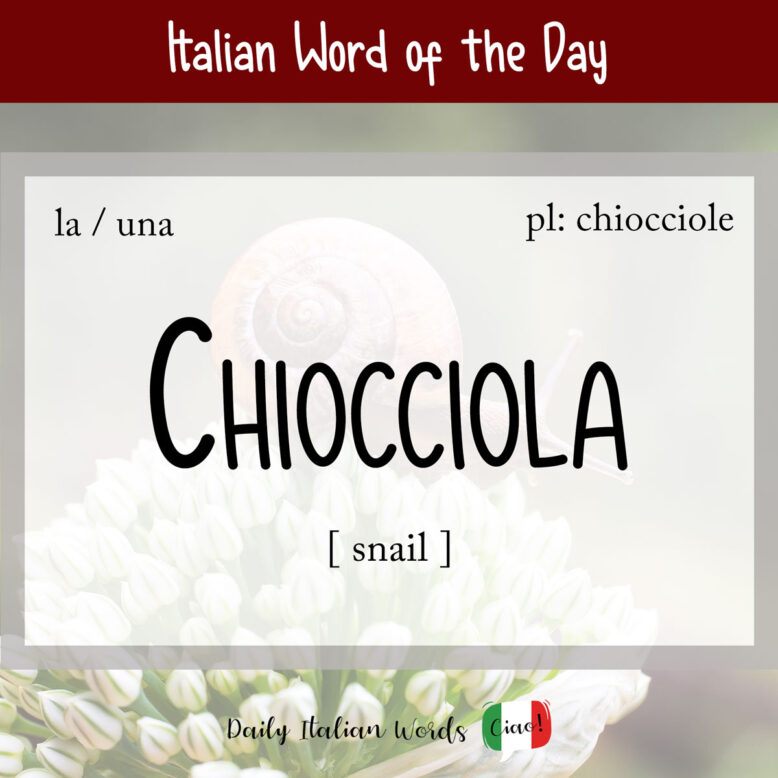
Chiocciola is a feminine noun and takes the following definite and indefinite articles:
- la chiocciola
- le chiocciole
- una chiocciola
- delle chiocciole
Pay close attention to the pronunciation: the first part chio- is pronounced ‘kyo’ with a hard C and the second part -cio- is pronounced like the English ‘ch’ followed by an ‘o’.
According to Treccani, chiocciola derives from the Latin cŏchlea, which in turn comes from the Ancient Greek κοχλίας (kokhlías). The Greek word referred to both snails and spiral shells, and is closely related to another word, κόχλος (kókhlos), meaning shellfish or conch. It is thought that chiocciola evolved in Vulgar Latin through a diminutive form (either *clociola or *cochleola), which then underwent metathesis – the rearranging of sounds – to form the modern Italian word.
La chiocciola uscì dal suo guscio a spirale.
The snail came out of its spiral shell.
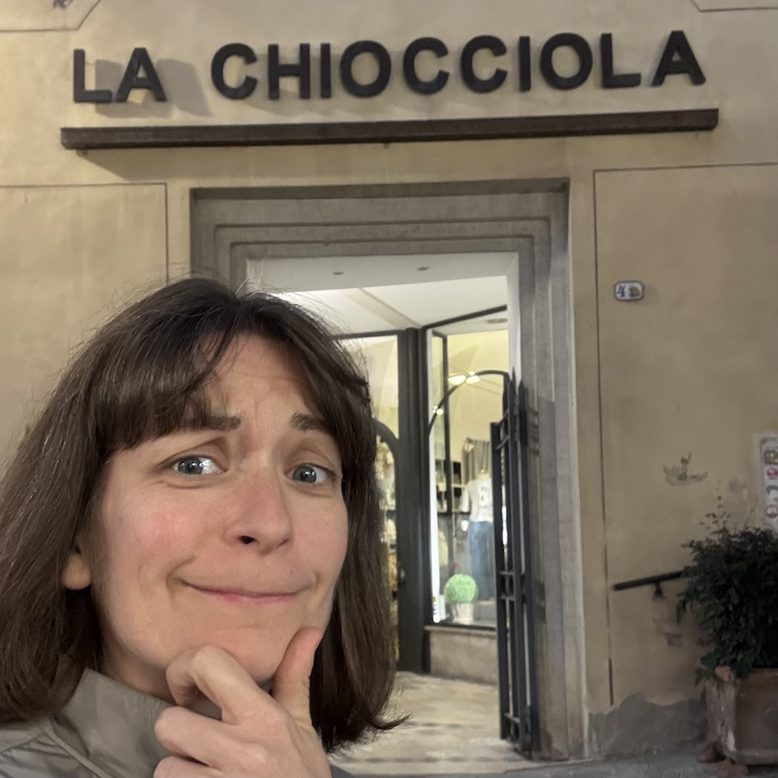
In everyday speech, it is very common for Italians to refer to snails as lumache (slugs), even though they have a guscio (shell). Lumaca is also more frequently used when they are eaten as food, along with the French term escargot.
Chiocciole e lumache si somigliano.
Snails and slugs look alike.
Children enjoy using the diminutive term chiocciolina – literally “little snail” – with the -ina ending.
Because of its spiral shape, chiocciola is also the word for the cochlea, the cavity of the inner ear.
To finish, here is a chicca (tidbit) that will surely delight you: the @ symbol in Italian is known as a chiocciola due to its resemblance to a snail’s shell.


Heather Broster is a graduate with honours in linguistics from the University of Western Ontario. She is an aspiring polyglot, proficient in English and Italian, as well as Japanese, Welsh, and French to varying degrees of fluency. Originally from Toronto, Heather has resided in various countries, notably Italy for a period of six years. Her primary focus lies in the fields of language acquisition, education, and bilingual instruction.