
From the 13th to the 16th century, men and women commonly wore light headdresses made of wool, cloth, or canvas, secured under the chin with laces. Over time, these evolved into a staple of women’s nightwear and a standard way to keep infants’ heads warm. In Italian, this style is known as a cuffia (cap or bonnet in English).
While these garments themselves have largely fallen out of fashion, the word remains a fixture in the modern language, referring to a range of different objects as we’ll discover below.
cuffia
cap / bonnet / headphone
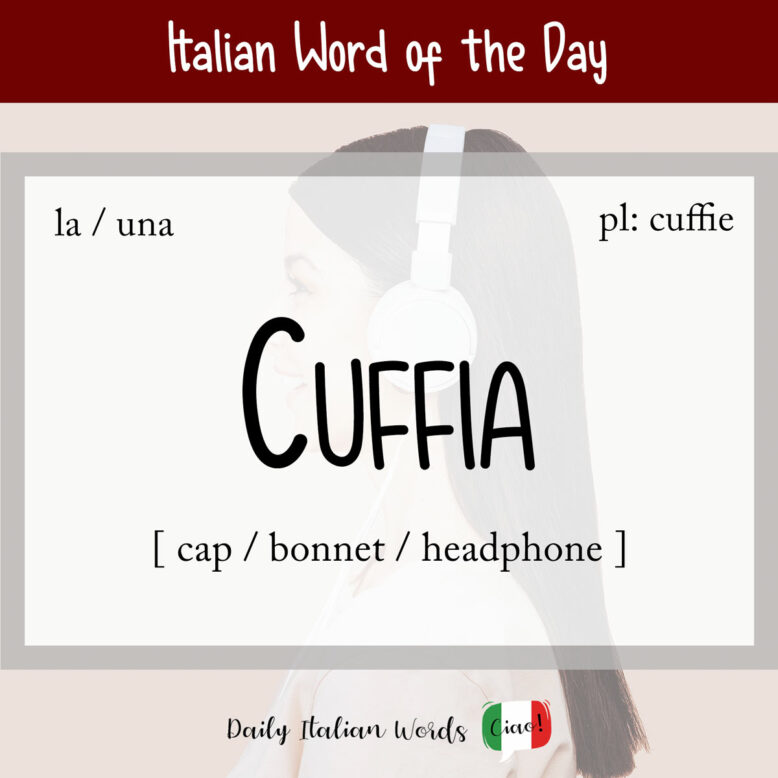
But first, a bit of grammar! Cuffia is a feminine noun which takes the following definite and indefinite articles:
- la cuffia = the cap
- le cuffie = the caps
- una cuffia = a cap
- delle cuffie = (some) caps
The first translation for cuffia is swimming cap, which can be called either cuffia da nuoto (“swimming cap”) or cuffia da piscina (“swimming pool cap”) in Italian.
Indosso una cuffia per evitare che l’acqua mi entri nelle orecchie.
I wear a cap to stop the water from getting into my ears.
Second is the cuffia da bagno, whose purpose is to protect the hair while you shower or have a bath. In English, we’d call this a shower cap.
For either of the aforementioned terms, you might also hear cuffia per capelli (“hair cap”).
Now we come to the much more modern and technological usages of cuffia. Almost always in its plural form, cuffie, it is used to refer to headphones or earphones. Note that these can also be called auricolari in Italian.
Ascolto la musica con le cuffie.
I listen to music with headphones.
In a completely different vein, cuffia can also refer to various types of shields or screens.
For example, it denotes the moveable stage element used to hide the prompter from the eyes of the audience during a performance. It also refers to the metal casing that covers the cups of radio-diagnostic and radiation therapy equipment. These are extremely technical terms, though, so you don’t need to worry about them in everyday life – unless you work in these fields, of course!

Did you know that…?
Cuffia was also used to refer to a type of ancient military headgear made of metal chain mail in the shape of a cap, which was generally worn under the helmet.
A fun idiom associated with this word is uscire per il rotto della cuffia, which literally translates as “to get out by the tear of the cap/bonnet.” The English equivalent is “to escape by the skin of one’s teeth.”
According to Accademia della Crusca, it likely originates from medieval jousting, where surviving a blow to the protective cuffia (cap) under a helmet was considered a narrow escape. An alternative interpretation links the phrase to passing through a small, damaged breach in city walls, symbolising a lucky, last-minute escape.

Heather Broster is a graduate with honours in linguistics from the University of Western Ontario. She is an aspiring polyglot, proficient in English and Italian, as well as Japanese, Welsh, and French to varying degrees of fluency. Originally from Toronto, Heather has resided in various countries, notably Italy for a period of six years. Her primary focus lies in the fields of language acquisition, education, and bilingual instruction.