
One of the primary ways we engage with the word is through our mani (hands), or more specifically, our fingers. In Italian, the word for a single digit is the masculine il dito, while the most commonly used plural is the feminine le dita. We will delve deeper into this phenomenon of masculine nouns becoming feminine in the plural below!
dito
In Italian, certain masculine nouns like il dito take a feminine plural like le dita because they trace back to Latin neuter plural nouns. In Latin, neuter plurals ended in an –a, and this collective -a ending was carried over into Italian to describe groups of things, especially body parts. Some other common examples include:
- il braccio (the arm) → le braccia (the arms)
- l’osso (the bone) → le ossa (the bones)
- l’uovo (the egg) → le uova (the eggs)
- il labbro (the lip) → le labbra (the lips)
The choice of plural depends entirely on how the fingers are being referenced.
- le dita (feminine): This is the most common plural. It refers to the collective group of fingers as a whole (e.g., “the fingers of the hand”)
- i diti (masculine): This is a rare, specific plural. It is used when referring to individual fingers considered separately (e.g., “the two thumbs” or “the index fingers of different people”)
Mi sono fatto male al dito.
I hurt my finger.
It’s also worth mentioning that the word dito can be used to refer, not only to fingers, but also to toes. When Italians want to specify that they are talking about the feet rather than the hands, you’ll hear le dita dei piedi (“the fingers of the feet“).
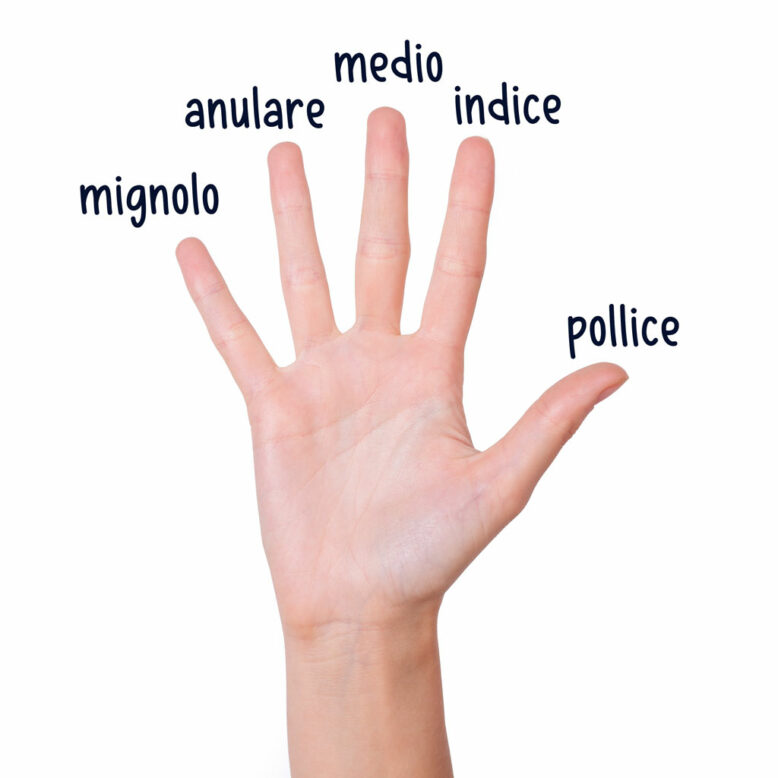
Now let’s take a quick look at the names of the different digits:
- il pollice = the thumb
- l’indice = the index finger
- il medio = the middle finger
- l’anulare = the ring finger
- il mignolo = the pinky finger
Italians also have a specific name for the big toe, which is l’alluce.
La mano ha cinque dita.
The hand has five fingers.
Here are some of the most common verbs you will see used with dito in Italian:
- schiacciarsi un dito = to crush one’s finger
- puntare il dito = to point one’s finger
- alzare il dito = to lift one’s finger
- indicare qualcosa/qualcuno con un dito = to point at something/someone
- segnare a dito = to point a finger at someone / call attention to
Did you know that…?
…dito can be used figuratively to describe a small amount of something. In English, we might use translations such as drop, splash, or inch to express the same idea.
C’è rimasto solo un dito d’acqua nel bicchiere. = There was only a drop of water left in the glass.
There are also quite a few interesting idiomatic expressions that contain dito. Let’s take a look at them now!
Girare il dito nella piaga
Literal translation: To turn the finger in the wound
English meaning: To pour salt into a wound / to rub it in
Toccare il cielo con un dito
Literal translation: To touch the sky with a finger
English meaning: To walk on clouds / to walk on air
Legarselo/a al dito
Literal translation: To tie it to your finger
English meaning: To bear a grudge

Heather Broster is a graduate with honours in linguistics from the University of Western Ontario. She is an aspiring polyglot, proficient in English and Italian, as well as Japanese, Welsh, and French to varying degrees of fluency. Originally from Toronto, Heather has resided in various countries, notably Italy for a period of six years. Her primary focus lies in the fields of language acquisition, education, and bilingual instruction.