
Some Italian words look unmistakably Italian: just think of casa, mangiare, bellissimo. What makes them look Italian? Well, they all end in a vowel, for one! Other words, however, can catch you totally off guard because they don’t seem particularly Italian at all. Sometimes they even look more like English, French, or, as in the case of our word of the day idem, Latin!
The word idem exists in English too, used specifically in citations to indicate an author or word that was just mentioned. In Italian, however, it has a much broader scope of meaning, as we’ll find out today.
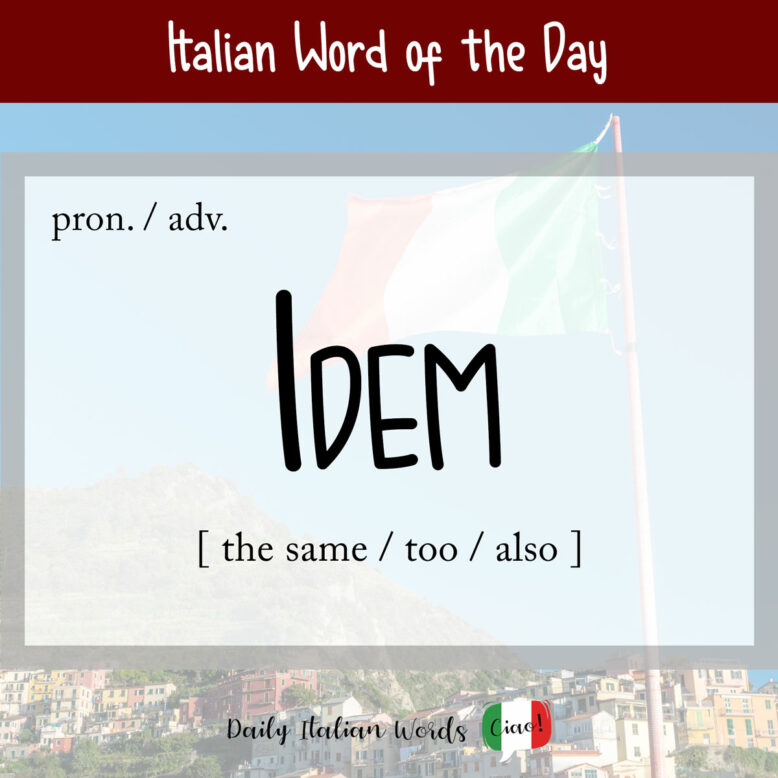
idem
the same / too / also / ditto
The dictionary Treccani describes idem as a Latin pronoun, referring to something that has already been mentioned, particularly in lists or references. (Sound familiar?) However it can also be used adverbially to mean any of the following, depending on the context:
- the same (thing)
- in the same way
- same here
- likewise
- too
- ditto
- also
- as well
Io sono stato uno sciocco, e tu idem.
I was a fool, and you were too.
Here, idem is roughly equivalent to also, too or as well in English. Notice how the pronouns io (I) and tu (you) have been retained in order to create contrast between the two subjects (io and tu).
As we suggested in the introduction, idem comes directly from Latin idem of the same spelling. It is the neuter form of the Latin demonstrative pronoun and adjective īdem, meaning the same or that same one.
And just a nice little linguistic connection as a side note: the same Latin idem also gave birth to the Italian identità (identity), which Treccani derives from Late Latin identĭtas.

There are two particularly useful patterns to remember when using the word idem. Let’s look at them now.
IDEM = the same thing / the same
Idem can be used when you don’t want to repeat something that has already been mentioned. In this case, it is considered a pronoun. For example:
Marco ha scelto il primo ristorante, io idem.
Marco chose the first restaurant, as did I / and I chose the same thing.
In lists and bibliographical references, idem can similarly indicate that the information is the same as what came immediately before. Keep in mind that it is often abbreviated as id. in such contexts.
IDEM = likewise / me too / same here
This adverbial usage of idem is especially common in informal language. Here are a couple of exchanges I could easily imagine my husband and I having:
Io adoro la pizza. – Idem!
I love pizza. – Same here!
Sono stanco morto… – Idem.
I’m exhausted… – Me too.
Italian, unlike English, has preserved idem as a living word used not only in formal and written contexts, but also informal conversation. So the next time an Italian says Idem!, don’t bother reaching for a dictionary – just know that he or she is in total agreement with you!

Heather Broster is a graduate with honours in linguistics from the University of Western Ontario. She is an aspiring polyglot, proficient in English and Italian, as well as Japanese, Welsh, and French to varying degrees of fluency. Originally from Toronto, Heather has resided in various countries, notably Italy for a period of six years. Her primary focus lies in the fields of language acquisition, education, and bilingual instruction.