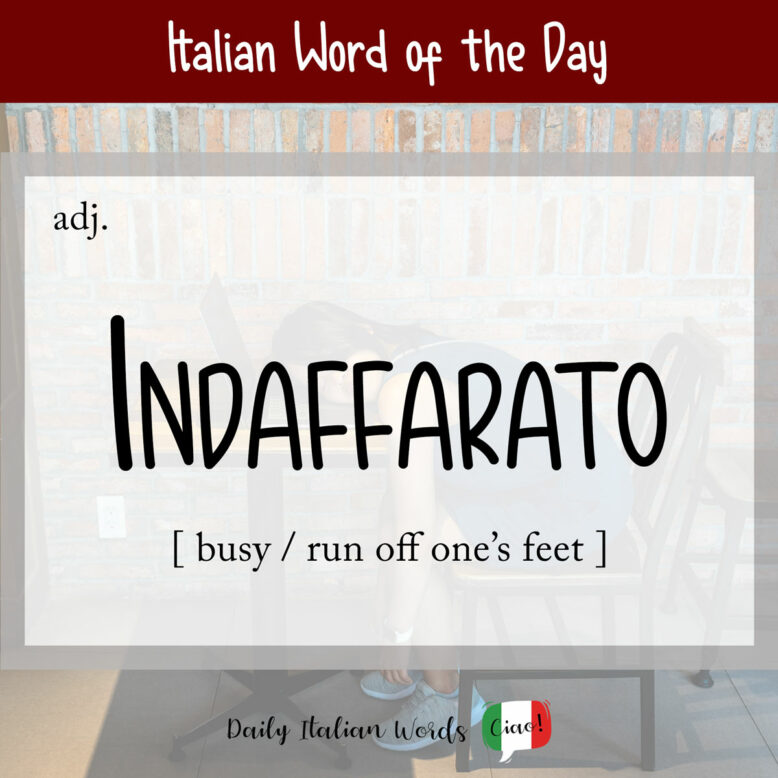
Indaffarato is an adjective meaning busy or run off one’s feet to use a more idiomatic translation. It comes from the noun daffare, meaning ‘work’ or ‘a lot to do.’
indaffarato
Being an adjective that ends in -o, the ending changes in accordance with the gender and number of the subject in question.
- indaffarato – masculine, singular
- indaffarata – feminine, singular
- indaffarati – masculine, plural
- indaffarate – feminine, plural
You may have come across another word for ‘busy’ in Italian which is impegnato. So, what’s the difference between them?
Whereas impegnato refers to being busy with an important task or obligation, indaffarato suggests that you are overwhelmed by the sheer number of things you need to complete. The latter projects an image of chaos, of someone juggling multiple responsibilities and barely keeping their head above water, while the former is a more purposeful, focused and systematic kind of busy.
You’ll also come across the term occupato which, for all intents and purposes, is pretty much synonymous with impegnato. If I were to be picky, I could say that impegnato – which comes from impegno meaning “task” or “errand” – implies that you are busy with a specific task, whereas occupato implies a more general kind of busyness which may or may not be all that important such as, for example, watching the clouds float by on a lazy summer’s day.
It should also be mentioned that while indaffarato only means busy, impegnato and occupato have a broader scope of meaning, namely:
- impegnato – in a relationship; booked or reserved; politically active
- occupato – occupied or taken (as in a seat on a train or phone line); employed
Vorrei tanto venire con voi ma oggi sono proprio indaffarato con il lavoro.
I would really like to come with you but I’m really busy with work today.
Sono troppo impegnato per dedicarmi ad altri progetti.
I’m too busy to devote myself to other projects.
Se non fossi così occupato, andrei in vacanza.
If I weren’t so busy, I’d go on vacation.


Heather Broster is a graduate with honours in linguistics from the University of Western Ontario. She is an aspiring polyglot, proficient in English and Italian, as well as Japanese, Welsh, and French to varying degrees of fluency. Originally from Toronto, Heather has resided in various countries, notably Italy for a period of six years. Her primary focus lies in the fields of language acquisition, education, and bilingual instruction.