I’m sure we’ve all met one of these people at least once in our lives: the colleague who laughs a bit too enthusiastically at the boss’s bad jokes, the student who showers the professor with compliments that would make even a Hallmark card blush. The kind of person who’s always super nice to someone important, not because they actually like them, but because they want something in return.
In Italian, we have plenty of words to describe them. But there’s one with a rather interesting backstory: ruffiano. It involves ancient Rome, red hair, and even a special corner of Dante’s Hell…
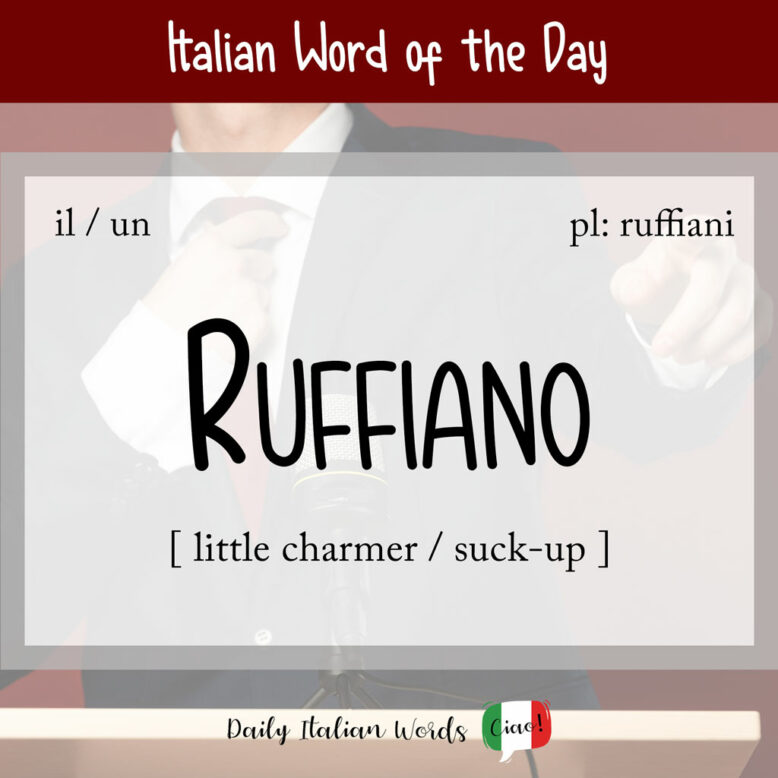
ruffiano
So, where does “ruffiano” come from?
The word comes from the Latin rufianus, which means “with red hair.” I know— what on earth does red hair have to do with being a suck-up? We’re getting there.
Back in the day, a ruffiano was the person who facilitated, shall we say, certain “romantic encounters.” Sometimes this meant arranging marriages, but more often it meant setting up meetings with prostitutes. In other words, a ruffiano was basically a sort of agent praising the ladies’ best qualities to get the clients interested.
The red hair connection has to do with the fact that in ancient Rome, prostitutes often dyed their hair red. So the word rufianus (“the red-haired one”) became a way to refer to such “facilitators.”
Ruffiani in Dante’s Inferno
Being a ruffiano was not exactly a noble profession, so much so that Dante Alighieri reserved a special place in Hell for them in the Divine Comedy. The eighth circle, to be precise, where they spend eternity being whipped by demons.
Among the lucky residents is Venedico Caccianemico, a 13th-century nobleman who prostituted his own sister to the Marquis of Este, hoping to score some political favours in return. Family values surely weren’t his forte!
What does “ruffiano” mean today?
Nowadays, the love business side has given way to a different meaning. A ruffiano is someone who puts on a big show of admiration, but it’s all fake. Every smile, every enthusiastic nod, every “what a brilliant idea!” is just an act. Behind it all, there’s always what we call a tornaconto (a personal gain). And most of the time, they’re not even good at hiding it, because everyone around them can see what they’re doing (everyone except, more often than not, the person being flattered).
Like the shopkeeper who won’t stop telling you how amazing you look in that jacket or that you have such a great taste, not because they mean it, but because they want you to swipe your credit card. Or the journalist who writes a glowing profile of a politician, conveniently leaving out anything controversial, hoping for a favour down the line.
Animals can be total ruffiani too! Take cats, who couldn’t care less about you all day and then suddenly become the sweetest creatures on the planet, nuzzling and purring with those big innocent eyes, but only when the food bowl is empty (classic!).
How to use “ruffiano” in Italian
Ruffiano is primarily a noun, though you may sometimes hear it used as an adjective too.
- il ruffiano (masculine singular)
- la ruffiana (feminine singular)
- i ruffiani(masculine plural)
- le ruffiane (feminine plural)
It’s casual and colloquial, but not necessarily that negative; it really depends on how you say it and who you’re talking about. If you say it with a smile about a friend or a kid, it’s more like a cute “you little charmer.” But if you say it with an eye-roll about a colleague at work, chances are it’s closer to “suck-up.”
Here are some classic examples:
- Che ruffiana!: What a little charmer!
- Sei proprio un gran ruffiano!: You really are such a little charmer. — gran is the shortened form of grande (big), and works here like “such a” or “a real,” adding emphasis to the word ruffiano)
- I tuoi gatti sono dei gran ruffiani!: Your cats are such suck-ups!
- Che post ruffiano!: What a suck-up post!
- Non sopporto quel sorriso ruffiano!: I can’t stand that suck-up smile!
To give the word more punch, add the -accio suffix and you get ruffianaccio. It’s like adding “big” or “total” in front. Again, the tone is key, as this suffix can make the term sound like a playful tease or give it a sharper edge.
Quel politico è un ruffianaccio, dice quello che la gente vuole sentirsi dire.
That politician is a total suck-up, he just says whatever people want to hear.
We also have two expressions we use all the time:
- Fare il ruffiano (literally, “to do the ruffiano”), which means to play the suck-up/little charmer. For instance:
Ehi signorina, non fare la ruffiana con me!
Hey young lady, don’t play the little charmer with me!
- Arruffianarsi qualcuno, which means to butter someone up.
Si è arruffianato il direttore in due settimane.
He’s already buttered up the director in two weeks.

Valentina Nicastro is a travel writer in love with her home country, Italy. Having travelled widely around the globe, she realised there was more to explore closer to home and decided to put the passport aside for a while. When she is not immersed in documenting Italy, you’ll find her donning her communication consultant hat, weaving words as a content writer and bridging linguistic divides as a translator.