
Whenever my son does something naughty, his response is almost always the same: It wasn’t me, mamma!
Because Italian is the language we speak at home, he says this to me in Italian, of course. There’s just one problem: what he says isn’t grammatically correct.
So, what does he say?
Non è stato me!
What he should really be saying is Non sono stato io. I can only put his mistake down to the influence of English on his Italian!
So, let’s take a closer look at how this phrase should be worded and, more importantly, why.
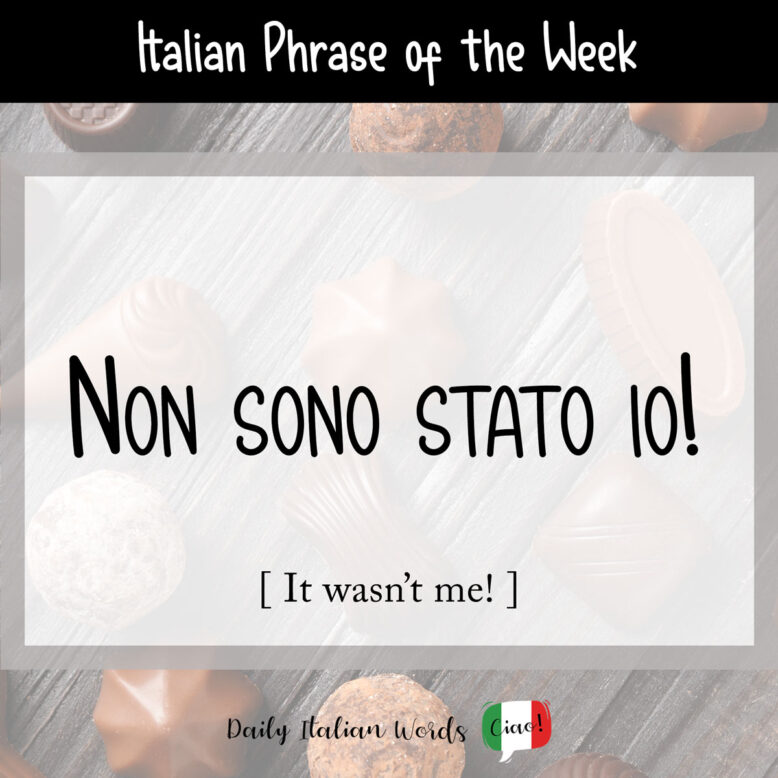
Non sono stato io!
It wasn’t me!
1. non = not
Non is a negative adverb in Italian whose meaning, in this case, is not.
It must be placed directly before the conjugated verb (i.e. sono stato) in order to make the sentence negative.
So far, so good!
2. sono stato = have been / was
Sono stato is the passato prossimo, or present perfect, of the verb stare (to be / stay), and can be translated as either ‘has been‘ or ‘was‘ depending on the surrounding context. It describes a completed past action.
Sono (I am) is the first-person singular present form of essere (to be), and stato (been) is the past participle of essere. Essere is a verb of being or state, so it must take itself as its own auxiliary, not avere (to have). In other words, it is never correct to say ho stato* instead of sono stato.
Sono stato al supermercato.
I was at the supermarket. / I have been to the supermarket.
Also keep in mind that stato can only be used if the person speaking identifies as male. The ending of stato must change to stata if a woman is speaking.
- sono = I am
- sono stato = I have been / I was (male speaking)
- sono stata = I have been / I was (female speaking)
You might be wondering why I haven’t mentioned the imperfect ero (was) here. The truth is that you can say Non ero io but only when referring to an ongoing state or a continuous action in the past. For example:
Penso di averti visto al supermercato… – Non ero io, ero a casa.
I think I saw you at the supermarket… – It wasn’t me, I was at home.
However, it is more common to use the phrase ‘it wasn’t me‘ when referring to a specific, completed action or event in the past, such as when you deny that you did something. For example:
Chi ha rotto il mio computer? – Non sono stato io!
Who broke my computer?! – It wasn’t me!
3. io = I / me
Finally we come to io, which is a personal pronoun functioning as the emphatic subject. It means I or me.
In Italian, subject pronouns (like io, tu, noi) are normally omitted because the verb ending already shows who is speaking. However, when you want to put strong emphasis on who did something, as in the case of this phrase, or create contrast, you must explicitly include the pronoun at the end.
È stato lui, non sono stato io!
It was him, it wasn’t me!
If we go back to my son’s grammatically incorrect phrase, you will notice that he uses me instead of io. In Italian, me doesn’t work here because it can only be used as a direct or indirect object, or after prepositions such as per (for), con (with) and so on. It cannot act as the subject of essere in this construction.


Heather Broster is a graduate with honours in linguistics from the University of Western Ontario. She is an aspiring polyglot, proficient in English and Italian, as well as Japanese, Welsh, and French to varying degrees of fluency. Originally from Toronto, Heather has resided in various countries, notably Italy for a period of six years. Her primary focus lies in the fields of language acquisition, education, and bilingual instruction.