Imagine biting into a scrumptious-looking ciambella (doughnut), only to discover that something about it isn’t quite right. Maybe it’s uneven, maybe it’s collapsed, or maybe, just maybe, it’s missing that all-important buco (hole) in the middle! (Can a doughnut really be called a doughnut if it’s missing the hole?!)
This situation perfectly captures both the literal and figurative meaning of the Italian idiomatic expression Non tutte le ciambelle escono col buco – literally “not all doughnuts come out with a hole.”
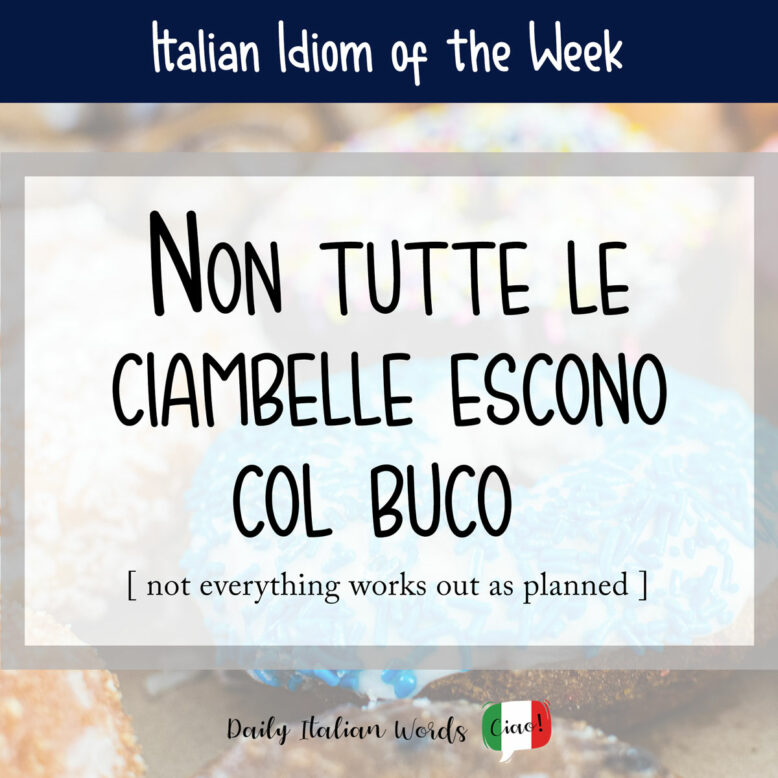
Non tutte le ciambelle escono col buco
Not everything works out as planned
In short, it means that no matter how carefully we plan or how much effort we put into our work, relationships, personal goals – or preparing homemade doughnuts! – things don’t always go as planned. That “missing hole” becomes a metaphor for those moments when results fall short of intentions.
Quite often, you will hear this idiom uttered wryly at the end of a conversation about things, both serious and non, that aren’t quite going to plan and for which there may be no solution. It is a verbal way of both acknowledging that perfection isn’t possible, and that in actual fact, a bit of imperfection may not be a bad thing! (Stack Exchange)
Note that you may also hear Non tutte le ciambelle riescono col buco, with the verb riuscire (to succeed) replacing uscire (to come out).
Here are some possible English equivalents, though, in my opinion, none of them quite capture the essence of the Italian idiom!
- You can’t win them all!
- You win some, you lose some!
- That’s life!
- That’s just the way it is.
- The best-laid plans (of mice and men often go awry)
- What are you going to do?
Il progetto non è andato bene come speravo, ma non importa: non tutte le ciambelle escono col buco.
The project didn’t go as planned, but it doesn’t matter: not everything goes according to plan.
Ho studiato tanto per l’esame, ma il risultato non è quello che speravo. Vabbè, non tutte le ciambelle riescono col buco.
I studied a lot for the exam, but the result wasn’t what I hoped for. Oh well, not everything turns out perfectly.


Heather Broster is a graduate with honours in linguistics from the University of Western Ontario. She is an aspiring polyglot, proficient in English and Italian, as well as Japanese, Welsh, and French to varying degrees of fluency. Originally from Toronto, Heather has resided in various countries, notably Italy for a period of six years. Her primary focus lies in the fields of language acquisition, education, and bilingual instruction.