There are few moments in life more satisfying than getting a lot while giving very little in return. You know the feeling: someone else is paying, the work is already done, the fridge is full, and somehow you’ve landed in the middle of it all thinking, Che bello! (How lovely!)
Italians have a word for that exact feeling: pacchia.
pacchia
good times / gravy train / sweet deal
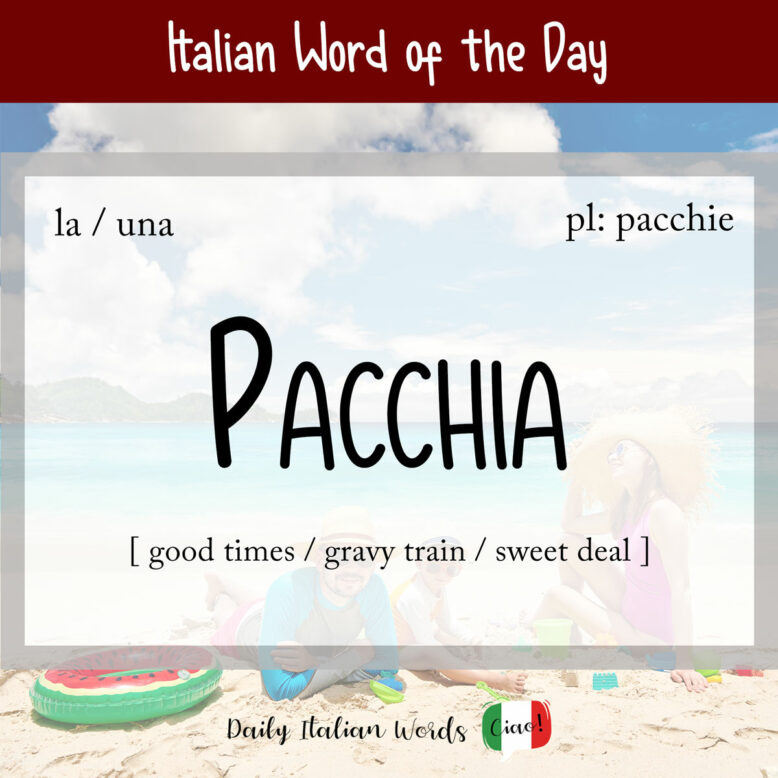
Pacchia (plural: pacchie) is a feminine noun that takes the following definite and indefinite articles:
- la pacchia
- le pacchie
- una pacchia
- delle pacchie
Imagine winning an all-expenses-paid trip to Italia. (In our dreams!) You arrive, your hotel is covered, your meals are paid for, the sun is shining, and your only real responsibility is deciding whether to go to the beach or stay by the pool. At some point, you look around, take a sip of your drink and say:
Che pacchia!
What a life of comfort! / What a sweet deal!
As you’ve probably guessed, pacchia is an Italian word used to describe a particularly happy or comfortable situation in which you find yourself enjoying an abundance of good things without having had to spend much money or make an effort to obtain them.
In other words, it’s the Italian equivalent of discovering that life is treating you extremely well, and you didn’t even have to work that hard for it. It can describe material abundance, an easy situation, a life of comfort, or simply an unexpectedly sweet deal.
Con questo nuovo lavoro, hai trovato una vera pacchia!
With this new job, you’ve really landed a sweet deal.
Pacchia is derived from the now near-obsolete Italian verb pacchiare, which, according to Treccani, is connected with the idea of eating or drinking heartily. The origin of pacchiare itself is unknown.
The most common form in which you’ll see it used is in the expression Che pacchia!, which we saw above. It can be translated as any of the following:
- What a life (of comfort)!
- What a sweet deal!
- This is the life!
- What a treat!
- How lucky are we!
- Living the dream!
- What a cushy situation!
Or if you speak like my classmates used to, you might simply exclaim Sweet! (Am I showing my age?)
For example, imagine you get an amazing new job. The salary is excellent, the hours are short, and there isn’t actually that much work to do. Your friend asks how it’s going and you respond…
Guadagno un sacco e lavoro pochissimo. – Che pacchia!
I earn loads and hardly work at all. – What a life!
You might also hear una vera pacchia or È cominciata la pacchia.
Perhaps you’re staying at your dear old auntie’s house, she’s stocked the fridge with heaps of pizza and ice cream, and she’s insisting you don’t lift a finger. You might whisper to yourself…
Qui non devo fare niente e c’è tutto quello che mi piace. Una vera pacchia!
I don’t have to do anything here and there’s everything I like. This is the life!
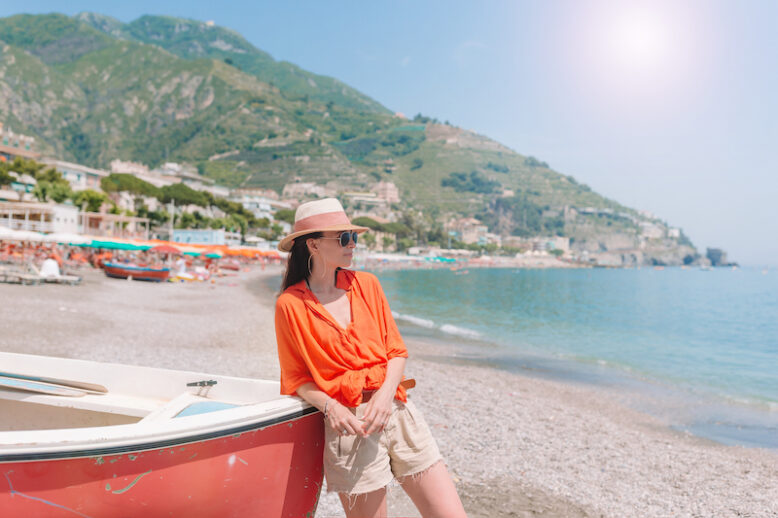
And, of course, we mustn’t forget our aforementioned all-expenses-paid trip to Italy. You’re lying on the beach with your best friend, spending practically nothing, while somebody else has taken care of the bill.
Vacanza pagata, hotel pagato, zero spese… È cominciata la pacchia!
Paid holiday, paid hotel, no expenses… I’m livin’ the dream!
Keep in mind that there is an important nuance to pacchia. It’s not simply about being happy or having lots of money. The word usually carries the idea that you’re enjoying an unusually good situation relative to the effort or expense involved in getting there. So, if you spend six months working incredibly hard to afford a luxury holiday, you might have an amazing time, but you wouldn’t necessarily call the situation pacchia.
Another expression you might encounter is La pacchia è finita or È finita la pacchia, used when the gravy train reaches the end of the line, or when the good times come to an end. This can be translated in a few ways including:
- The party is over
- The honeymoon phase is over
- The fun is over
- The good times have come to an end
Ragazzi, è finita la pacchia: il direttore è tornato.
Guys, the fun is over: the manager is back.
So the next time life unexpectedly hands you an absurdly comfortable situation or a fantastic deal, don’t just say you’re fortunato (lucky). Say it like a real Italian: Che pacchia!

Heather Broster is a graduate with honours in linguistics from the University of Western Ontario. She is an aspiring polyglot, proficient in English and Italian, as well as Japanese, Welsh, and French to varying degrees of fluency. Originally from Toronto, Heather has resided in various countries, notably Italy for a period of six years. Her primary focus lies in the fields of language acquisition, education, and bilingual instruction.