My son started piano lessons a few months ago, and while I usually have to coax him into practising with rewards such as TV time or ice cream, he is definitely starting to show some significant progress. In fact, I could even say ci sta prendendo la mano!
prenderci la mano
to get the hang of it
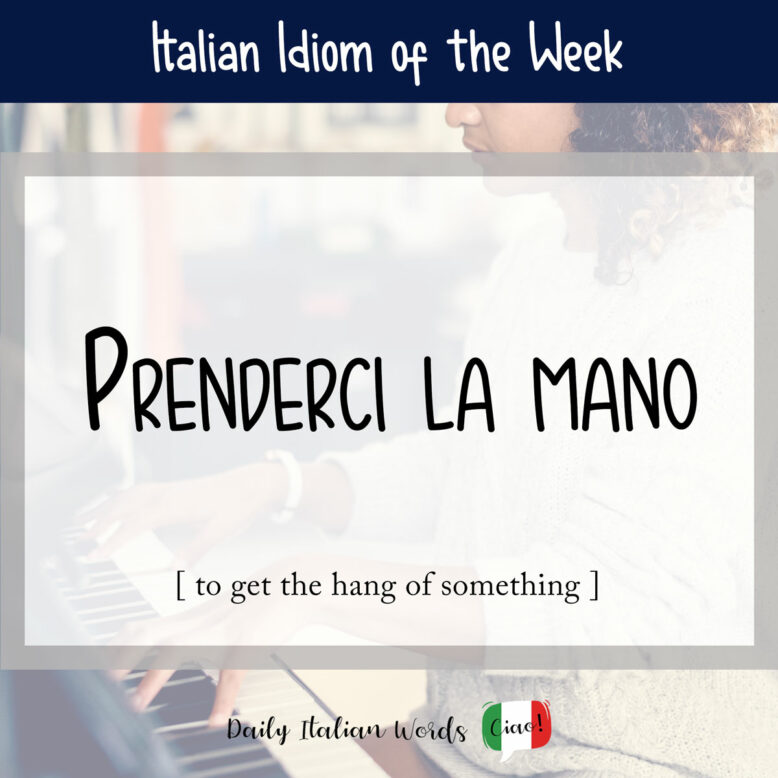
Prenderci la mano is an idiomatic expression meaning roughly to get the hang of it, to get used to doing it or to become good/comfortable at it through practice. We can break it down in the following way:
- prendere = to take
- ci = to it / with it / of it (here, ci refers back to the activity or thing you’re learning to do)
- la = the feminine definite article “the”
- mano = hand
So the literal translation is something along the lines of “to take the hand at it.” This, of course, sounds strange in English because Italian is using mano figuratively. Just imagine that your hand is getting used to doing something new, and with each attempt, is making fewer and fewer mistakes.
Mi ci sono voluti anni per riuscire a suonare bene il pianoforte. Dopo un po’ ci prenderai la mano anche tu, vedrai.
It took me years to be able to play the piano well. After a while, you’ll get the hang of it too, you’ll see.
In the previous example sentence, we can see that ci points to the activity was previously mentioned – that is, learning to play the piano. You can only drop the ci if the activity you are referring to is explicitly mentioned in the sentence. For example:
Spero di prendere la mano con il nuovo programma.
I hope to get the hang of the new program.
Here, con il nuovo programma is clearly stated, so there is no need to repeat ourselves by inserting ci.
An expression that is synonymous with prenderci la mano is farci la mano, which simply swaps out prendere (to take) for fare (to do/make).
Sei diventato velocissimo a costruire i treni Lego. Ormai ci hai fatto la mano!
You’ve become really fast at building Lego trains. You’ve really got the hang of it now!

Farsi prendere la mano + Prendere la mano
Prenderci la mano can be easily confused with two other expressions, one of which is also figurative and the other, quite literal.
First, let’s look at the literal phrase prendere la mano – this simply means “to take (someone’s) hand,” as in a child’s hand while crossing the street.
Ho preso la mano di Elio prima di attraversare la strada.
I took Elio’s hand before crossing the street.
The second – farsi prendere la mano – is idiomatic, and it means to get carried away with something or to lose control.
Sono andato a fare la spesa con l’idea di prendere due cose. Poi ho guardato il carrello e ho capito che mi sono fatto prendere la mano…
I went shopping with the idea of picking up just two things. Then I looked at the cart and realised I’d gotten carried away…
Ho installato WhatsApp sul telefonino di mia mamma, ma adesso si è fatta prendere la mano e passa tutto il giorno a mandarmi messaggi!
I installed WhatsApp on my mom’s phone, but now she’s gotten carried away and spends the whole day sending me messages!

Heather Broster is a graduate with honours in linguistics from the University of Western Ontario. She is an aspiring polyglot, proficient in English and Italian, as well as Japanese, Welsh, and French to varying degrees of fluency. Originally from Toronto, Heather has resided in various countries, notably Italy for a period of six years. Her primary focus lies in the fields of language acquisition, education, and bilingual instruction.