Feeling exhausted lately? Believe me, you’re not alone. Maybe it’s the relentless summer heat draining your energy, or, like me, un bambino birichino (mischievous boy) who’s had you up before sunrise every single day since birth. Whatever the cause, there’s a perfect Italian word that captures it all: spossatezza.
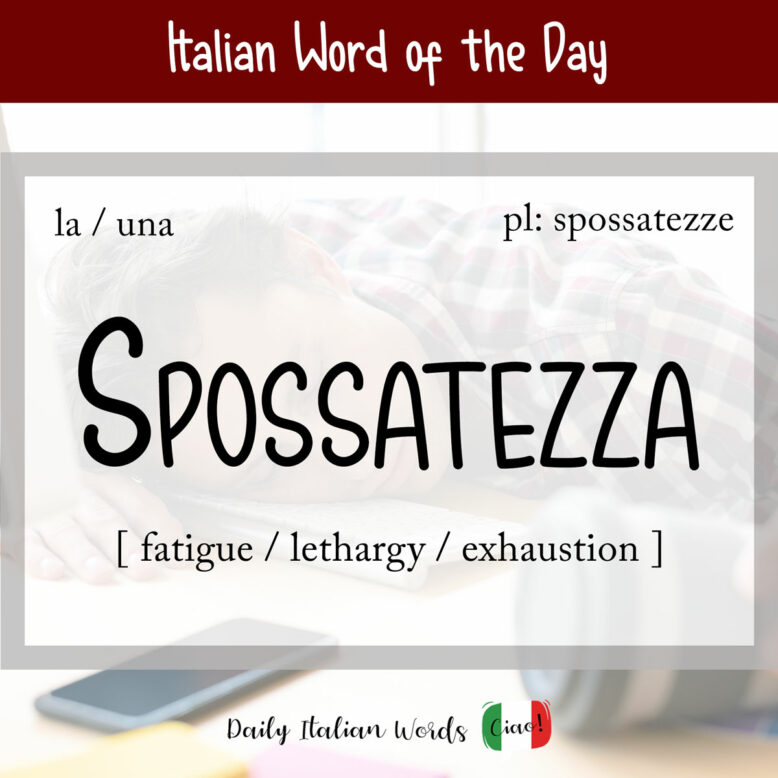
spossatezza
fatigue / lethargy / exhaustion
Spossatezza is a feminine noun that comes from the verb spossare (to exhaust), which has an interesting formation and history. It is derived from possa, a literary noun meaning strength, power, or energy (and related to the modal verb potere = to be able / can).
Ho avuto un raffreddore che mi ha spossato parecchio.
I had a cold that really wore me out.
It takes the prefix s-, which in Italian often has a privative or negative sense (like de- or dis- in English), meaning to remove or deprive of. So s- + possa = spossare or literally
to deprive someone of strength.
The suffix -ezza is what is known as a noun-forming suffix. From the Latin -itia, it is often used for somewhat more concrete or classical qualities. (Elon.io) What’s more, it is always feminine. Some other nouns that use this suffix include bellezza (beauty – bello + -ezza), altezza (height – alto + -ezza) and carezza (caress – caro + -ezza).
Un po’ di esercizio fisico quotidiano aiuta a ridurre la spossatezza cronica.
A little daily physical exercise helps reduce chronic fatigue.
Curiously, the past participle spossato (exhausted) is actually attested earlier than the verb itself. This suggests that the verb spossare was likely formed later, back-derived from the already existing adjective spossato (weary / tired / exhausted). (Source: Treccani)
Speaking of derived terms, we also have the adjective spossante meaning exhausting or draining.
Here are the definite and indefinite articles used with spossatezza:
- la spossatezza
- una spossatezza
- le spossatezze
- delle spossatezze
You may be wondering: are there any synonyms for spossatezza? The answer is sì! Stanchezza is probably the easiest to remember since it derives from stanco (tired), an adjective I’m sure you’ve all encountered since you started learning Italian. But the more advanced fiacchezza (derived from fiacco = listless) is a good option too.
Fa così caldo… non so cosa fare per combattere questa spossatezza estiva!
It’s so hot… I don’t know what to do to beat this summer lethargy!


Heather Broster is a graduate with honours in linguistics from the University of Western Ontario. She is an aspiring polyglot, proficient in English and Italian, as well as Japanese, Welsh, and French to varying degrees of fluency. Originally from Toronto, Heather has resided in various countries, notably Italy for a period of six years. Her primary focus lies in the fields of language acquisition, education, and bilingual instruction.