I don’t know about you, but it’s hard for me to imagine a world without the ever-present tastiera, which is the Italian word for keyboard. Back in school in the ’90s, I wrote out all my notes by hand, and there’s plenty of evidence suggesting that this method can improve memory retention. Still, when it comes to crafting long-form articles or emails, nothing quite matches the satisfaction of tapping out my thoughts to the steady rhythm of the keys.
tastiera
keyboard
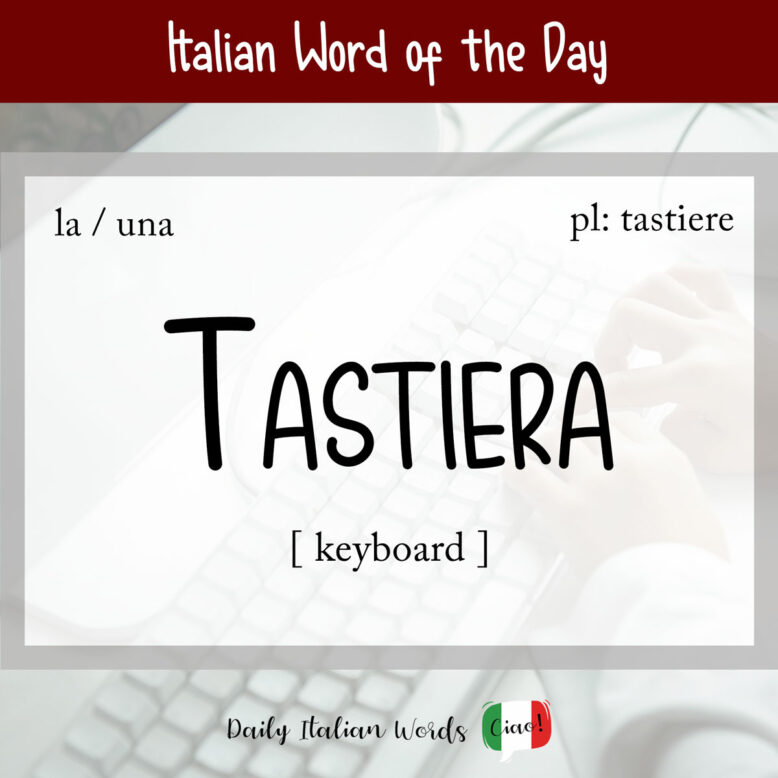
Tastiera is a feminine noun and it takes the following definite and indefinite articles:
- la tastiera = the keyboard
- le tastiere = the keyboards
- una tastiera = a keyboard
- delle tastiere = some keyboards
It is a derivative of tasto, which is the word for a key or button. Tasto, in turn, comes from the verb tastare, meaning to feel / touch.
Questa tastiera è molto comoda e non costa tanto.
This keyboard is very comfortable and doesn’t cost much.
While the first translation that comes to my mind is a computer keyboard, there are other kinds of tastiere in the world, including the kind of keyboard used to make music, and the fingerboard, the flat strip on the neck of a stringed instrument (such as a guitar) against which the strings are pressed.
And we mustn’t forget the apparecchio telefonico a tastiera, the push-button telephone, which has sadly become obsolete in today’s world except for in museums. (My son saw one as we were exploring a National Trust manor house one day, and couldn’t figure out what it was!)


Heather Broster is a graduate with honours in linguistics from the University of Western Ontario. She is an aspiring polyglot, proficient in English and Italian, as well as Japanese, Welsh, and French to varying degrees of fluency. Originally from Toronto, Heather has resided in various countries, notably Italy for a period of six years. Her primary focus lies in the fields of language acquisition, education, and bilingual instruction.