
A common noun with a dual meaning in Italian is tenda, which can be translated as either curtain (or drapes in US English) or tent depending on the context. Let’s discover it now!
tenda
curtain / tent
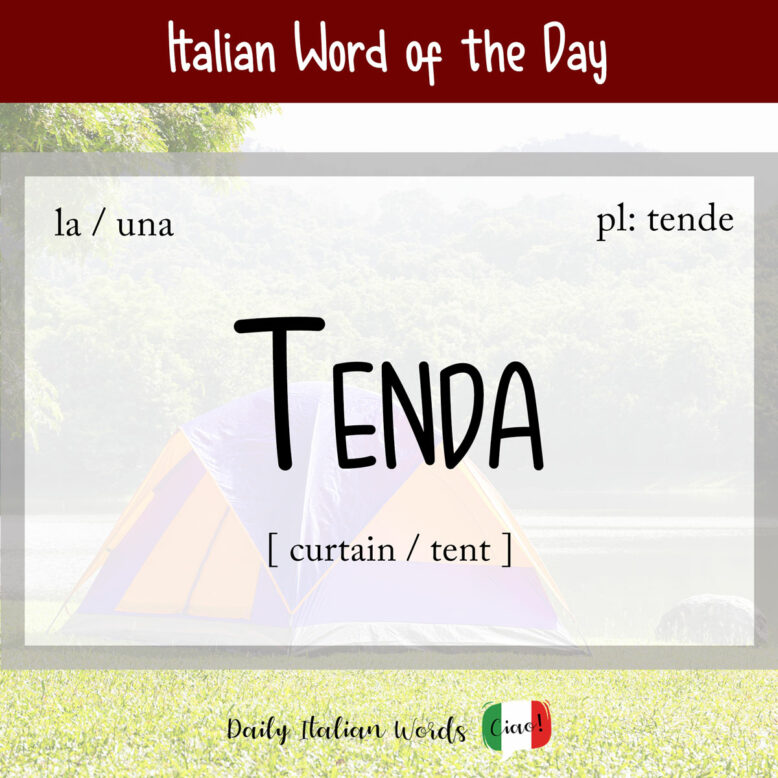
The word derives from the Medieval Latin word tenda. It is a derivative of the Latin verb tendĕre, meaning to stretch or to extend. In essence, a tenda is defined by the action of stretching fabric across a frame, which applies whether you are talking about a curtain or tent.
As you may have guessed from the -a ending, tenda is a feminine noun that takes the following definite and indefinite articles:
- la tenda = the curtain / tent
- le tende = the curtains / tents
- una tenda = a curtain / tent
- delle tende = some curtains / tents
1. TENDA = Curtain / drapes
Because they usually occur in pairs, it is more common to see tenda used in its plural form, tende.
When it’s just a tad too sunny out, or you want to get some shut eye, the best way to invite the darkness in is by chiudere le tende (closing the curtains) or tirare le tende (drawing the curtains). Even more effective are tende oscuranti (blackout curtains), also known as tende di oscuramento.
Hai voglia di aprire le tende? Non vedo un tubo.
Do you mind opening the curtains? I can’t see a thing.
By extension, you’ll hear the singular tenda used to describe an awning in front of a shop or hotel, as well as to describe la tenda per la doccia (the shower curtain), used to keep running acqua (water) inside the bathtub.
When talking about blinds, most people will just say tende without any additional descriptors, but if you want to be more precise, you can describe them as tende a rullo (rolling blinds), tende avvolgibili (roller blinds), tenda a pacchetto (Roman blinds) or tende veneziane (Venetian blinds). You may also encounter the terms gli avvolgibili, where the adjective avvolgibile (roll-up) has become a noun, and la tapparella (sunblind).
Abbassiamo le tende – c’è troppa luce in questa stanza.
Let’s lower the blinds – there’s too much light in this room.
The augmentative tendone tends to be used to describe awnings, or any very large curtain such as those used for theatrical performances. The diminutive tendina, on the other hand, refers to various kinds of small curtains, as well as the shutter curtain inside a camera. It also appears in the term menù a tendina, the word for a drop-down menu.
Note that when you are talking about tende teatrali (theatre curtains), you also have the option of using the synonym sipario.

2. TENDA = Tent
As you know by now, tenda can also refer to a tent. This translation should be easier to remember because it closely resembles the English equivalent.
When you imagine a tent, the first kind that usually springs to mind is the tenda da campeggio, the camping tent. A popular option is the tenda canadese (Canadian tent), a very small A-frame tent that is easy to construct even using makeshift materials. Other options include la tenda a igloo, an igloo-shaped tent, and la tenda da campo, generally used by the military.
I’d be happy sleeping in any of the above but there is one kind of tent I don’t want to end up inside: la tenda a ossigeno (oxygen tent)!
The most common verbs you’ll see used with tenda are montare (to pitch) and smontare (to take down).
Mi aiuti a montare la tenda?
Can you help me pitch the tent?
Coming back to our augmentative tendone, it is used to describe any large tent, such as a circus tent, or pavilion.
Tenda, in this sense of the word, also appears in two useful idiomatic expressions with opposite meanings: piantare le tende and levare le tende.
The former, which literally translated as to plant one’s tent, is used to describe the act of settling in at someone’s home and taking advantage of their hospitality. For example, if my brother suddenly asked me to put him up for a week, and ended up freeloading for three months, I could begrudging complain to my husband that he had piantato le tende. Note that it can also be used literally when describing people who set up tends outside government buildings in protest, or venues hours or days ahead of a popular concert or event.
The latter, on the other hand, is close to our English idiom to pull up stakes, or in plain English, to pack up and move to a different place. However, in Italian, levare le tende can assume different nuances depending on the context. It can imply that you pack up and move suddenly and quickly, for example, if you’ve been evicted because you haven’t paid the rent, or can be used to tell someone to leave (e.g. Devi levare le tende = You need to leave).
Finite le vacanze, i turisti levano le tende.
Once the holidays are finished, tourists pack up and leave.


Heather Broster is a graduate with honours in linguistics from the University of Western Ontario. She is an aspiring polyglot, proficient in English and Italian, as well as Japanese, Welsh, and French to varying degrees of fluency. Originally from Toronto, Heather has resided in various countries, notably Italy for a period of six years. Her primary focus lies in the fields of language acquisition, education, and bilingual instruction.