If you’ve ever tried to describe someone as beautiful in English, you might opt for phrases like natural beauty or fresh-faced. But in Italian, they take a much more literal – and, dare I say, charming – approach. Enter the idiomatic expression acqua e sapone, which translates as water and soap.
Yes, you read that right. Italians compliment someone by basically saying they look like they just washed their face!
acqua e sapone
naturally beautiful without make-up
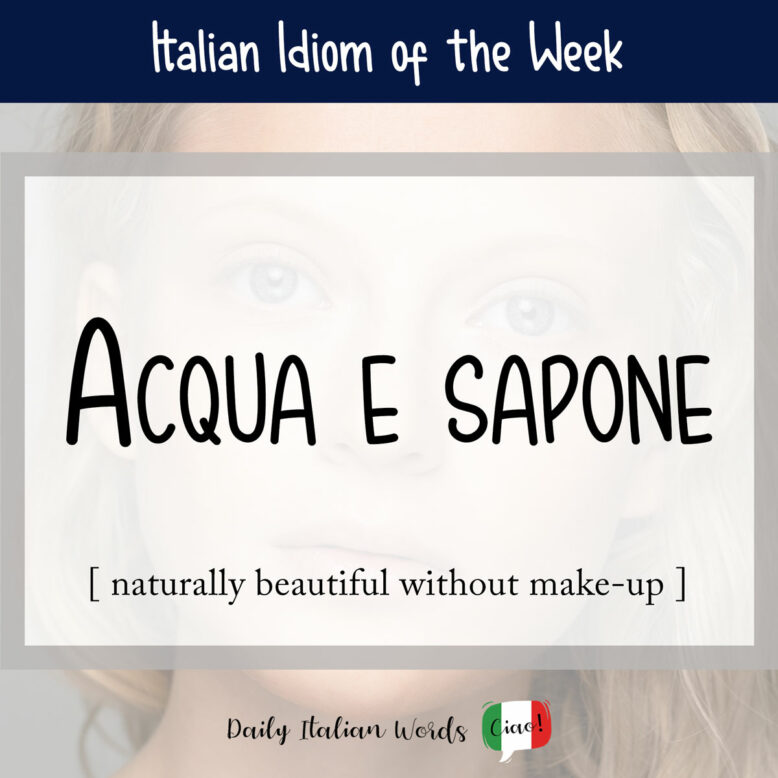
But before you imagine a soggy, just-out-of-the-shower look, this idiom actually captures something much more physically appealing: a kind of simple, unpretentious beauty that doesn’t rely on il trucco (make-up). At the end of the day, it’s all about being comfortable in your own pelle (skin).
Grazia è molto bella anche acqua e sapone.
Grazia is very beautiful even without make-up.
So how did “water and soap” become a go-to compliment in Italian? Let’s find out now!
For generations, especially before the rise of modern cosmetics, personal care was minimal. L’igiene (cleanliness/hygiene) was what counted and meant exactly what the phrase suggests: water and soap, nothing more, nothing less, and certainly nothing fancy. Over time, as make-up and elaborate make-up removal routines became the norm, it came to celebrate a kind of beauty that doesn’t try too hard.
It goes without saying that this idiom is almost always used to describe women rather than men given that they are the primary users of make-up.
Mario preferisce le ragazze acqua e sapone.
Mario prefers girls who don’t wear make-up.
Of course, acqua e sapone can also refer literally to water and soap, and there is even a non-food value retailer called Acqua & Sapone. If that weren’t enough, it is also the name of a former professional continental cycling team based in Italy, the title of a 1983 romantic comedy by Carlo Verdone, and the name of a rather catchy song from the ’80s by Stadio!


Heather Broster is a graduate with honours in linguistics from the University of Western Ontario. She is an aspiring polyglot, proficient in English and Italian, as well as Japanese, Welsh, and French to varying degrees of fluency. Originally from Toronto, Heather has resided in various countries, notably Italy for a period of six years. Her primary focus lies in the fields of language acquisition, education, and bilingual instruction.