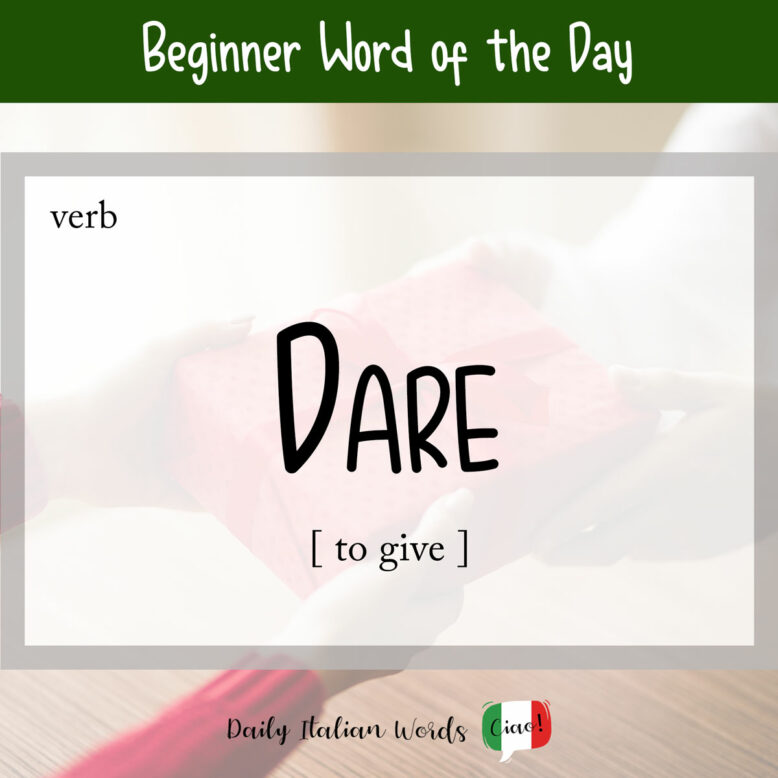
Today we are going to focus on a verb that, in many ways, forms the backbone of the Italian language along with other important verbs like fare (to do/make), avere (to have) and essere (to be). That verb is dare (to give), and you can hear how it’s pronounced below:
dare
to give
Dare may look like a regular -ARE verb on the surface, but it is actually very irregular. It conjugates the following way in the present tense. (Note that the third person dà requires an accent on the a, but the first person do does not require an accent on the o.)
io do = I give
tu dai = you give (inf., sing.)
lui / lei dà = he / she gives
Lei dà = you give (form., sing.)
noi diamo = we give
voi date = you (all) give
loro danno = they give
Below are two of the other most common tenses with which you need to be familiar: the passato prossimo and imperfetto.
io ho dato = I gave / have given
tu hai dato = you gave / have given (inf., sing.)
lui / lei ha dato = he/she gave / has given
Lei ha dato = you gave / have given (form., sing.)
noi abbiamo dato = we gave / have given
voi avete dato = you (all) gave / have given
loro hanno dato = they gave / have given
io davo = I gave / was giving
tu davi = you gave / were giving (inf., sing.)
lui / lei dava = he / she gave / was giving
Lei dava = you gave / were giving (form., sing.)
noi davamo = we gave / were giving
voi davate = you (all) gave / were giving
loro davano = they gave / were giving
Dare, in most cases, is the exact equivalent of the verb “to give” in English. Here are just a few examples of how “to give” maps perfectly onto dare despite the subtle changes in meaning.
- “to give” as in “to hand over” → dare una penna a qualcuno = to give someone a pen
- “to give” as in “to gift” → dare un regalo* = to give a present
- “to give” as in “to communicate” → dare una buona notizia = to give good news
- “to give” as in “to prescribe” → dare gli antibiotici a qualcuno = to give someone antibiotics
- “to give” as in “to award” → dare un premio = to give a prize
- “to give” as in “to indicate” → dare indicazioni = to give directions
- “to give” as in “to grant” → dare il permesso = to give permission
Note: although the use of dare is not incorrect, Italians prefer the verb regalare (to give, to donate, to gift) when talking about something they give as a gift. For example: Gli ho dato un libro per il suo compleanno (I gave him a book for his birthday) is grammatically correct, but you’ll hear more often Gli ho regalato un libro per il suo compleanno (lit. I gifted him a book for his birthday).
Gli ho dato una matita.
I gave him a pencil.
Dammi un attimo per pensare!
Give me a moment to think!
Diamo da mangiare a questo cane affamato.
Let’s give this starving dog something to eat.
Here is just a small taster of all the dare expressions that translate as “to give.” As you can imagine, they are quite easy to remember for native English speakers!
- dare adito a qualcosa = to give rise to something
- dare un calcio = to give a kick
- dare il cinque = to give a high five
- dare da mangiare a qualcuno = to give someone something to eat
- dare cinque anni al ladro = to give the thief five years (in prison)
- dare tutto se stesso = to give one’s all
- dare in sposa = to give away (a bride)
- dare il meglio / massimo = to give one’s best
- dare la propria parola = to give one’s word
- dare la precedenza = to give right-of-way
- dare alla luce = to give birth
- dare un passaggio = to give someone a ride

That being said, there are some cases where dare and “to give” don’t perfectly correspond, and it’s these expressions I’d like to concentrate on in this article.
1. Dare = to cause
In many cases, the verb dare can be used as a synonym for causare (to cause). It appears in common expressions like dare fastidio (to bother, or literally, to cause annoyance), dare problemi (to cause problems), dare scandalo (to cause a scandal), dare da pensare (to cause someone to think), and dare noia (to annoy / bother someone).
Basta darmi fastidio!
Stop bothering me!
2. Dare = to pay
Don’t be surprised if you see dare used as a synonym for the verb “to pay” as well. For example, the phrase ho dato cinquecento euro per il computer (literally “I gave five-hundred euros for the computer) sounds perfectly natural in Italian, whereas in English, we tend to be more specific by explicitly saying “to pay” – that is, unless the person being paid is mentioned (i.e. I gave him five-hundred euros for the computer).
Ho dato venti euro per il vaso.
I paid twenty euros for the vase.
3. Dare = to hold / show / perform
In the world of entertainment, we tend to “show” movies at the cinema, “hold or throw” parties, and “perform or put on” shows, performances and plays in English. In Italian, all these individual verbs can be replaced by dare.
For example, you might hear someone ask Quando danno il nuovo film di De Niro? which means When are they showing the new De Niro film? Likewise, you could translate Danno una festa domani sera as They are giving a party tomorrow evening, but these days, it’s more common to hear the verbs “to hold” or “to throw.”
Danno un film divertente in televisione stasera.
They’re showing a funny movie on TV tonight.
4. Dare = to think / to imagine
Now we come to a very idiomatic usage of dare! You may hear it used as a substitute for pensare (to think) but only in a very specific circumstance – when referring to a person’s age, particular if it’s unknown and you’re trying to guess what it might be!
Quanti anni gli dai? – Boh, almeno 50 anni.
How old do you think he is? – I dunno, at least 50.
(literally “How many years do you give him?”)
5. Dare (del) = to call / to address
When you meet a stranger for the first time – particular someone who is older than you – it is common practice in Italian to dargli / darle del Lei, which means to address (someone) as “Lei” rather than the more informal tu. As time goes on, and you get to know that person better, he or she may tell you to dargli / darle del tu instead.
Dammi pure del tu se vuoi.
You can address me with “tu” if you want.
This isn’t the only case you’ll hear dare del as a synonym for to call/address. It’s often paired with insults like cretino, idiota or scemo as you can see in the example below:
Non dare dello scemo ad una persona che neanche conosci. È molto maleducato.
Don’t call someone you don’t even know an idiot. It’s very rude.
6. Dare (per) = to presume
By combining dare with the preposition per (for), you create a verb that is similar in meaning to presume. Here are a few of the most popular expressions in which you’ll encounter dare per:
- dare per vero = to accept as true
- dare per disperso = to presume missing
- dare per morto = to give (someone) up for dead
- dare per scontato = to take for granted
- dare per certo = to be sure (of something)
Non do niente per scontato ormai.
I no longer take anything for granted.
7. Dare (su) = to look out onto / to tend towards
When used as an intransitive verb – that is, a verb that doesn’t take a direct object – dare can mean either to look out onto, in reference to the view from a building from above, or to tend towards when talking about shades and colour. However, it must be combined with the preposition su (on) or one of its articulated forms (sul, sulla, etc.).
Il mio appartamento dà sulla piazza.
My apartment looks out over the square.
Il colore di questo vestito dà sul blu.
This dress is a bluish colour.
8. Darsi = to give oneself
When dare becomes the reflexive darsi (literally to give oneself), it appears in a wide range of idiomatic expressions that can’t really be condensed into one singular translation. Let’s take a look at some of them now:
- darsi da fare = to get busy / to get on with something (literally “to give oneself things to do”)
- darsi per vinto = to give in (literally “to give oneself up as won”)
- darsi al bere = to take to drink (literally “to give oneself to drinking”)
- darsi alla bella vita = to have a good time (literally “to give oneself to the good life”)
- darsi alla musica = to devote oneself to music (literally “to give oneself to music”)
Si è dato al gioco per scappare dai suoi problemi.
He’s taken to gambling to escape from his problems.
And we mustn’t forget that darsi appears in two extremely important expressions: può darsi (perhaps / maybe) and si dà il caso che (it so happens that).
Did you know that…?
In addition to being a verb, dare also functions as a noun, meaning debit. Those involved or interested in la contabilità (accounting) may come across the expression il dare e l’avere, which means debits and credits.
Dare, like many versatile verbs, carries a wide range of meanings that can’t always be neatly summed up in a single definition. While it often aligns with the English “to give”, there are plenty of expressions where its meaning shifts in ways that aren’t immediately obvious. In these cases, it’s less about logic and more about learning each phrase as it comes.
Before we diamo fine a this article, let’s take a look at some of the most common idiomatic expressions with dare that fall outside the categories we’ve already covered.
- dare a intendere = to lead (someone) to believe (something)
- dare a vedere = to show / reveal
- dare addosso a = to hound / harass
- dare sui nervi = to get on one’s nerves
- dare alla testa = to go to one’s head
- dare atto = to acknowledge / recognise
- dare buca = to stand (someone) up
- dare del filo da torcere = to give someone a hard time
- dare ragione = to agree
- dare un esame = to sit an exam
- dare un’occhiata = to glimpse
- dare di matto = to go crazy
- dare fiducia = to trust
- dare fuoco = to set on fire
- dare i numeri = to go crazy
- dare il benvenuto = to greet / welcome
- dare il via / inizio = to launch
- dare l’idea = to make clear / illustrate
- dare la colpa = to blame
- dare le spalle = to turn one’s back on
- dare luogo a = to make happen
- dare nell’occhio = to attract attention
- dare retta = to listen / pay attention to
- dare una mano = to lend a hand

Heather Broster is a graduate with honours in linguistics from the University of Western Ontario. She is an aspiring polyglot, proficient in English and Italian, as well as Japanese, Welsh, and French to varying degrees of fluency. Originally from Toronto, Heather has resided in various countries, notably Italy for a period of six years. Her primary focus lies in the fields of language acquisition, education, and bilingual instruction.