
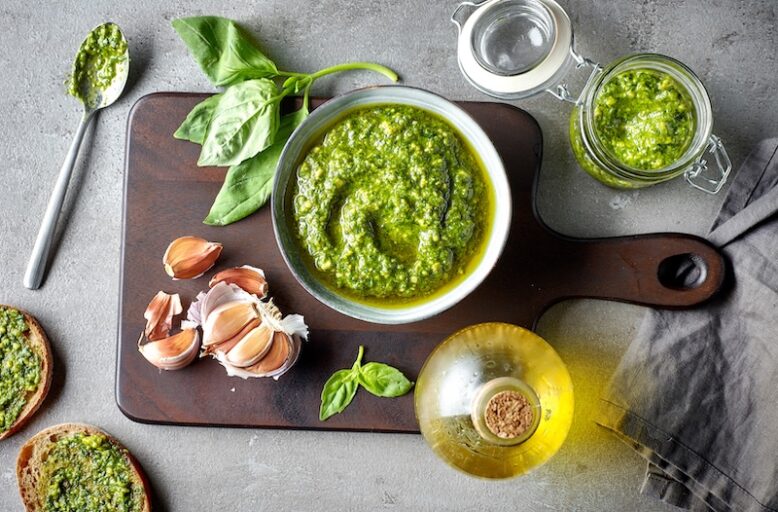
Put together some basilico (basil), pinoli (pine nuts), fresh parmigiano and aglio (garlic), along with some olio d’oliva (olive oil), succo di limone (lemon juice), and sale (salt), and what do you get? One of the most delicious sauces on the planet: pesto!
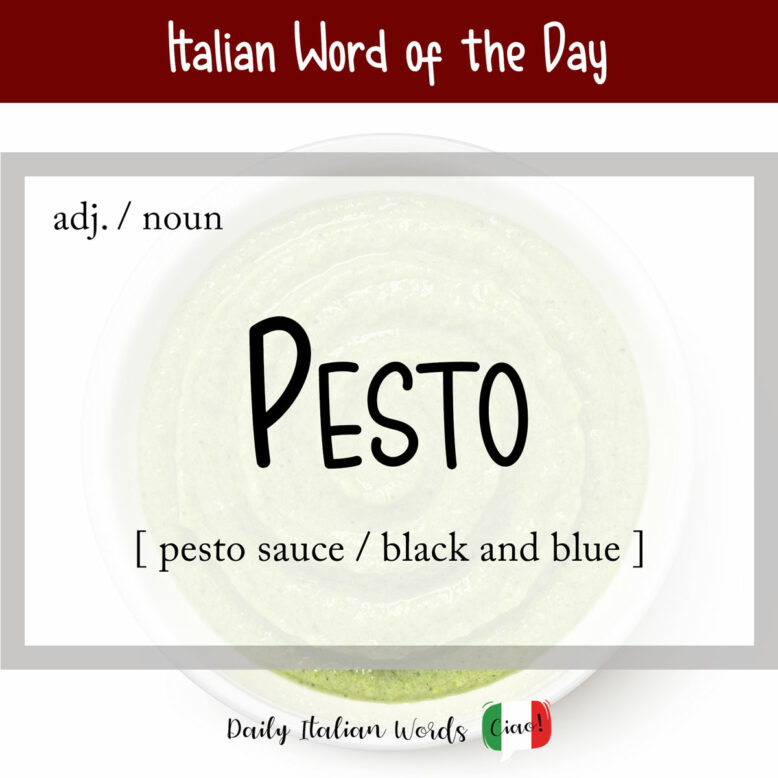
pesto
pesto sauce / black and blue
Pesto is also widely known as pesto alla genovese (or more simply pesto genovese) because it originated in the Ligurian city of Genova.
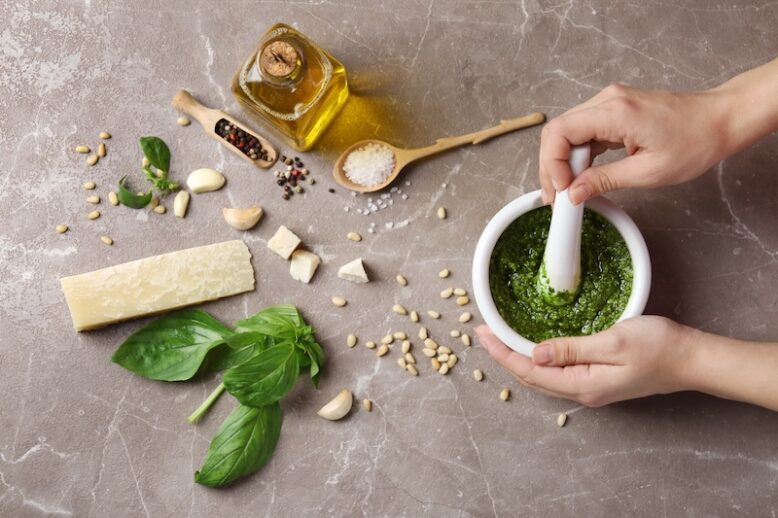
According to Treccani, pesto is the past participle of the verb pestare (or pestâ in Genovese), meaning to pound or to crush. This fits perfectly with the sauce: traditional pesto is made by crushing ingredients together, originally with a mortaio e pestello (mortar and pestle) but more recently with a food processor. The same Latin root is the basis for pestle.
Pesto is a masculine noun that takes the following definite and indefinite articles. You won’t really encounter its plural form pesti.
- il pesto
- un pesto
Versiamo il pesto sulla pasta.
Let’s pour the pesto onto the pasta.
In a figurative sense, pesto doesn’t refer to the sauce at all – it is an adjective that describes something dark, bruised, or dull-looking. A couple of common examples you will encounter in everyday Italian are:
- buio pesto = pitch darkness (so dark you can’t see anything at all)
- occhi pesti / avere i pesti agli occhi = eyes that look bruised, black and blue, or
tired, with dark circles, like when you’re exhausted or unwell – the closest equivalent is “to have bags under one’s eyes” (for tiredness) or “to have a black eye” (for a bruised eye) - avere le ossa peste = literally “to have bruised bones,” used when your body is aching from illness, fatigue, or a beating
When used as an adjective, the ending must show whether it is masculine or feminine and singular or plural to match the noun.
- pesto = masculine, singular
- pesti = masculine, plural
- pesta = feminine, singular
- peste = feminine, plural
Perché ha la faccia tutta pesta? – Beh, qualcuno gli ha tirato un sacco di pugni ieri notte…
Why is his face all black and blue? – Well, someone punched his lights out last night…
Before we bring this article to a close, it is worth mentioning that pesto is also the first-person singular of the verb pestare (to beat up / pound / crush).
- io pesto = I crush
- tu pesti = you crush (singular, informal)
- lui pesta = he crushes
- lei pesta = she crushes / you crush (singular, formal)
- noi pestiamo = we crush
- voi pestate = you crush (plural)
- loro pestano = they crush
Pesto il pesto con mortaio e pestello.
I crush the pesto with the mortar and pestle.

Heather Broster is a graduate with honours in linguistics from the University of Western Ontario. She is an aspiring polyglot, proficient in English and Italian, as well as Japanese, Welsh, and French to varying degrees of fluency. Originally from Toronto, Heather has resided in various countries, notably Italy for a period of six years. Her primary focus lies in the fields of language acquisition, education, and bilingual instruction.