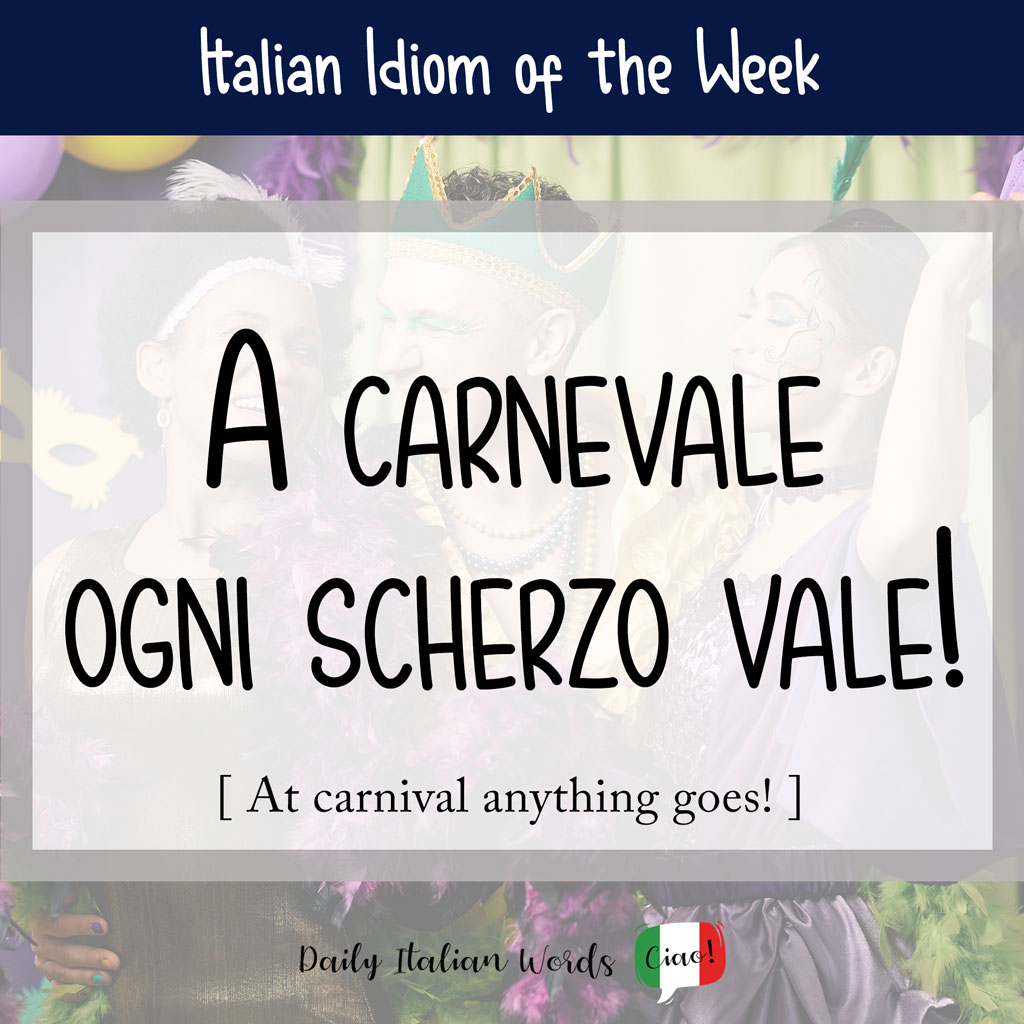
Italian Idiom: A carnevale ogni scherzo vale! (At carnival anything goes!)

Italian Idiom "A carnevale ogni scherzo vale"

Winter (inverno) can be a gloomy time of year in Italy, but it is brightened annually by the arrival of carnevale (carnival), a festival that takes place during the week before Lent (quaresima) involving music, processions, dancing and people dressed up in elaborate costume. A fun saying you can learn in preparation for this beloved …

Read more

Italian Word of the Day: Volpe (fox)

The Italian word for fox is volpe (feminine, plural: volpi). It derives from the Latin word vulpes of the same meaning. Two species of fox with which most people are familiar are the volpe rossa (red fox) and the volpe artica (arctic fox). In total, there are twelve separate extant species and four fossil species. …

Read more

Italian Phrase: Ciao, amore mio! (Hello, my love!)

Valentine’s Day may be over, but there’s never a bad time to learn a romantic Italian greeting, wouldn’t you agree? Ciao, amore mio! Hello, my love!Hi, my love! Let’s break it down into its component parts: ciao Ciao is a standard informal greeting in Italian that translates as hello / hi when you meet someone …

Read more

Italian Word of the Day: Cervellotico (bizarre / illogical)

The adjective cervellotico in Italian translates in numerous ways including bizarre, illogical, irrational or odd. It can describe bizarre people, as well as things that don’t correspond to the truth or aren’t founded on reason. Because it is an adjective, the ending changes according to the gender and/or plurality of the subject. For example: Masculine …

Read more

Italian Word of the Day: Mucca (cow)

The Italian word for cow is mucca (feminine, plural: mucche). As in English, the word refers to the female of a domesticated breed of ox that produces milk (latte) or beef (carne bovina). To milk a cow in Italian translates as mungere una mucca. Molti allevatori continuano a mungere le loro mucche a mano. Many …

Read more

Italian Word of the Day: Rotto (broken)

The adjective rotto in Italian can refer to anything that is damaged, out of order or in pieces including machines, clothes, household objects, and body parts to name a few. It is the past participle of the verb rompere meaning to break. Being an adjective, rotto also has corresponding feminine and plural forms with different …

Read more